JEE Main · 2024 · 30 Jan 2024 · Shift 1 · Laws of Motion

WhatsApp Email
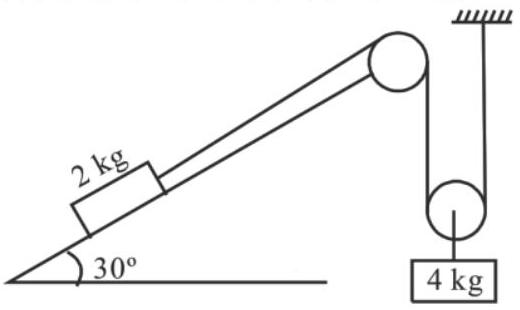
All surfaces shown in figure are assumed to be frictionless and the pulleys and the string are light. The acceleration of the block of mass 2 kg is :
  1. (A)g
  2. (B)✓ Correct
  3. (C)
  4. (D)

Answer: (B)

Solution

Let the acceleration of the 2 kg block be and that of the 4 kg block be (from the pulley constraint).

For the 4 kg block:

For the 2 kg block:

From the second equation, ; substituting into the first, .

The acceleration of the 2 kg block is .

JEE Main · 2024 · 30 Jan 2024 · Shift 1 · Single correct option

More JEE Main questions on Laws of Motion

  1. A simple pendulum has a bob with mass and charge q . The pendulum string has negligible mass. When a uniform and horizontal electric field is applied, the tension in the string changes. The final tension in the string, when pendulum attains an equilibrium positi …
    JEE Main 2026View solution →
  2. A large drum having radius R is spinning around its axis with angular velocity , as shown in figure. The minimum value of so that a body of mass M remains stuck to the inner wall of the drum, taking the coefficient of friction between the drum surface and mas …
    JEE Main 2026View solution →
  3. A spring of force constant is cut into two pieces. If the ratio of their length is , then the force constant of smaller piece is ______
    JEE Main 2026View solution →
  4. In the given figure the blocks A, B and C weigh 4 kg, 6 kg and 8 kg respectively. The co-efficient of sliding friction between any two surfaces is 0.5. The force required to slide the block C with constant speed is ______ N. (Used …
    JEE Main 2026View solution →
  5. A block of mass 5 kg is moving on an inclined plane which makes an angle of with the horizontal. Friction coefficient between the block and inclined plane surface is . The force to be applied on the block so that the block will move down witho …
    JEE Main 2026View solution →
  6. A particle of mass m falls from rest through a resistive medium having resistive force, , where v is the velocity of the particle and k is a constant. Which of the following graphs represents velocity (v) versus time(t)?
    JEE Main 2026View solution →