Let f(x)=2x2+5x∣−3∣,x∈R. If m and n denote the number of points where f is not continuous and not differentiable respectively, then m+n is equal to :
(A)5
(B)2
(C)0
(D)3✓ Correct
Answer: (D)
Solution
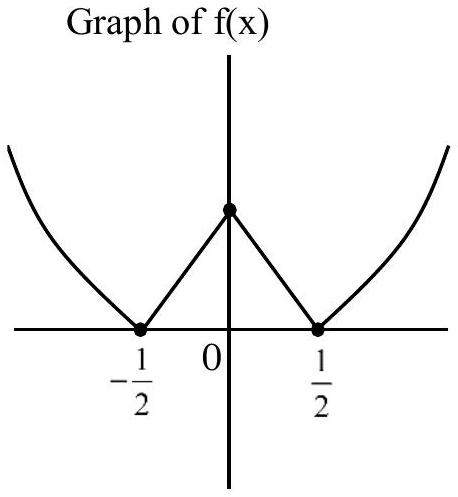
Let g(x)=2x2+5∣x∣−3, so f(x)=∣g(x)∣. Since g is even, work on x≥0 first: g(x)=2x2+5x−3=(2x−1)(x+3), which vanishes at x=21 (the root x=−3 is outside x≥0). By symmetry g also vanishes at x=−21.
Continuity: g is a sum of a polynomial and 5∣x∣, both continuous everywhere, so g — and hence f=∣g∣ — is continuous everywhere. So m=0.
Differentiability: for x>0, g′(x)=4x+5; for x<0, g(x)=2x2−5x−3 and g′(x)=4x−5. At x=0 the right-hand derivative is 5 and the left-hand derivative is −5, so g itself has a corner at x=0. Since g(0)=−3=0, taking the modulus does not smooth this out, so f is non-differentiable at x=0.
At x=±21, g has a simple (transversal) zero — it changes sign there rather than just touching zero — so ∣g∣ has a genuine V-shaped corner at each of these points too.
So f fails to be differentiable at x=0,21,−21, giving n=3.
m+n=0+3=3.
JEE Main · 2024 · 01 Feb 2024 · Shift 2 · Single correct option