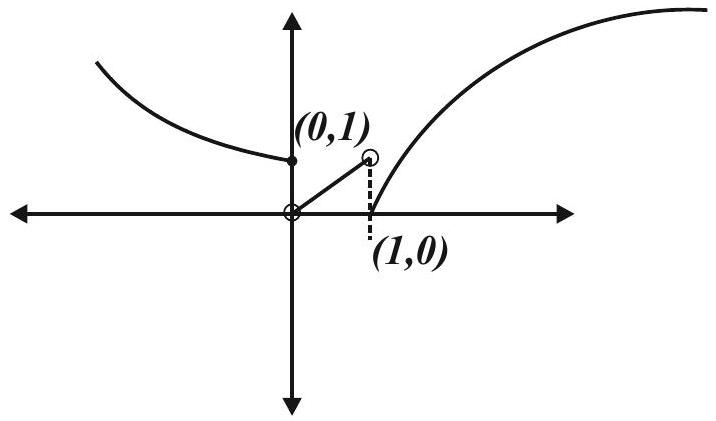
Let f:R→R and g:R→R be defined as f(x)={logexe−x,x>0,x≤0 and g(x)={xex,,x≥0x<0. Then, gof :R→R is :
(A)one-one but not onto
(B)neither one-one nor onto✓ Correct
(C)onto but not one-one
(D)both one-one and onto
Answer: (B)
Solution
f(x)=lnx for x>0, f(x)=e−x for x≤0; g(x)=x for x≥0, g(x)=ex for x<0.
For x≥1: f(x)=lnx≥0⇒g(f(x))=lnx. For 0<x<1: f(x)=lnx<0⇒g(f(x))=elnx=x. For x≤0: f(x)=e−x≥1>0⇒g(f(x))=e−x.
Not one-one: At x=2 (branch x≥1), g(f(2))=ln2. At x=ln2≈0.69 (branch 0<x<1), g(f(ln2))=ln2. Two different inputs give the same output, so g∘f is not one-one.
Not onto: The three branches give ranges [0,∞) (from x≥1), (0,1) (from 0<x<1), and [1,∞) (from x≤0); the union is [0,∞), which is not all of R (no negative value is attained). So g∘f is not onto.
Hence g∘f is neither one-one nor onto.Graph of g(f(x))
JEE Main · 2024 · 01 Feb 2024 · Shift 1 · Single correct option