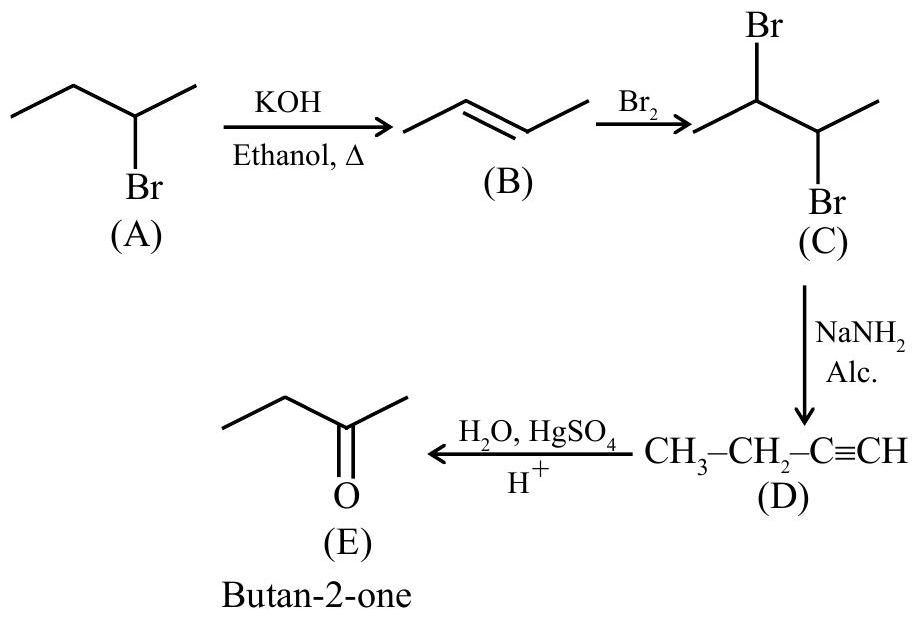
An optically active alkyl halide CX4HX9Br [A] reacts with hot KOH dissolved in ethanol and forms alkene [B] as major product which reacts with bromine to give dibromide [C]. The compound [C] is converted into a gas [D] upon reacting with alcoholic NaNHX2. During hydration 18 gram of water is added to 1 mole of gas [D] on warming with mercuric sulphate and dilute acid at 333 K to form compound [E]. The IUPAC name of compound [E] is :
(A)But-2-yne
(B)Butan-2-ol
(C)Butan-2-one✓ Correct
(D)Butan-1-al
Answer: (C)
Solution
The optically active halide CX4HX9Br is 2-bromobutane. Heating with alcoholic KOH brings about dehydrohalogenation, and by Saytzeff's rule the more substituted alkene but-2-ene is the major product [B]. Addition of bromine across this double bond gives 2,3-dibromobutane [C]. Treating this vicinal dibromide with alcoholic NaNHX2 removes two molecules of HBr to build the alkyne but-2-yne [D]. The stated 18 g of water is exactly one mole for the one mole of alkyne, so a single Markovnikov addition occurs; with HgSOX4 and dilute acid the alkyne adds water to an enol that tautomerises to a carbonyl compound. Hydration of the four-carbon alkyne in this way yields butan-2-one.
JEE Main · 2025 · 02 Apr 2025 · Shift 1 · Single correct option