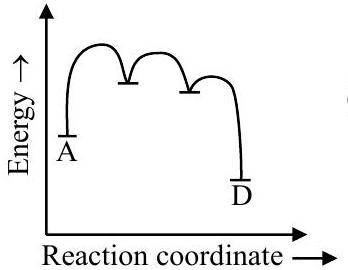
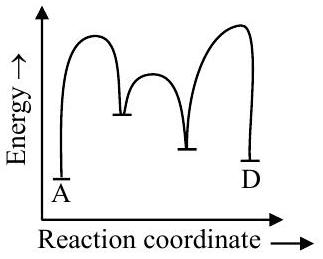
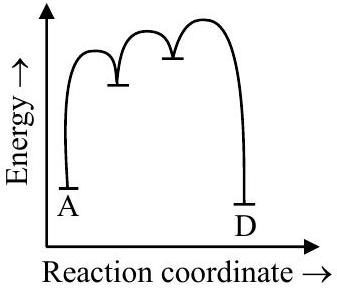
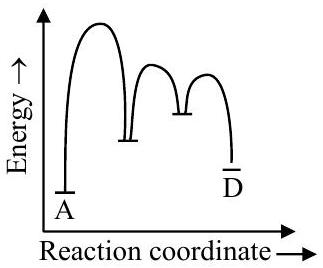
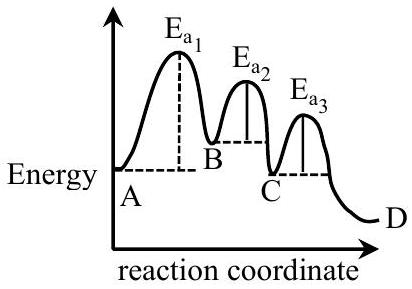
Reactant A converts to product D through the given mechanism (with the net evolution of heat) : A→B slow; ΔH=+ve B→C fast; ΔH=−ve C→D fast; ΔH=−ve
Which of the following represents the above reaction mechanism?
(A)(see structure)✓ Correct
(B)(see structure)
(C)(see structure)
(D)(see structure)
Answer: (A)
Solution
The first step AB is slow, so it crosses the highest activation barrier, and it is endothermic, so the first intermediate B lies above the reactant A. The next two steps BC and CD are fast, each crossing only a small barrier, and both are exothermic, so the energy drops at each stage. Because the overall change evolves heat, the product D lies below A. The correct energy profile rises steeply over a large first barrier to an intermediate above A, then descends through two small barriers to a product lying below the starting level.
JEE Main · 2025 · 02 Apr 2025 · Shift 2 · Single correct option