JEE Main · 2026 · 21 Jan 2026 · Shift 2 · Coordination Compounds

WhatsApp Email
Identify the metal ions among , , , and having a spin-only magnetic moment value more than 3.0 BM. The sum of unpaired electrons present in the high spin octahedral complexes formed by those metal ions is .

Answer: 7

Solution

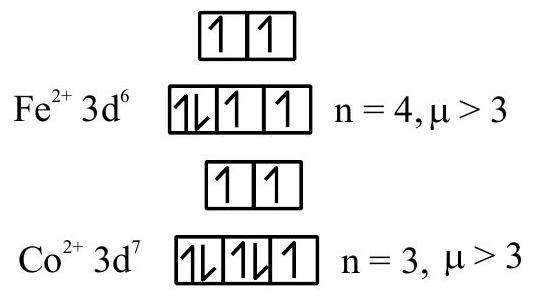
A spin-only moment above 3.0 BM needs at least three unpaired electrons, since three give BM while two give only BM. In high-spin octahedral fields, (), () and () each have two unpaired electrons at BM and are excluded, whereas () has three unpaired electrons ( BM) and () has four ( BM), both clearing the limit. Adding the unpaired electrons of the two qualifying ions, , gives a sum of 7.

JEE Main · 2026 · 21 Jan 2026 · Shift 2 · Integer answer
More JEE Main questions on Coordination Compounds

  1. Given below are two statements:

    Statement I: Among , , and , …
    JEE Main 2026View solution →
  2. Consider the transition metal ions and and all form low spin octahedral complexes. The correct decreasing order of unpaired electrons in their respective d-orbitals of the complexes is
    JEE Main 2026View solution →
  3. A first row transition metla (M) does not liberate gas from dilute HCl .1 mol of aqueous solution of is treated with excess of aqueous KCN and then is passed through the solution. The amount of MS …
    JEE Main 2026View solution →
  4. Given below are two statements:

    Statement I: Crystal Field Stabilization Energy (CFSE) of is greater than that of .

    Statement II: Pot …
    JEE Main 2026View solution →
  5. is a paramagnetic complex. Identify the INCORRECT statements about this complex.
    A. The complex exhibits geometrical isomerism.
    B. The complex is white in colour.
    C. The calculated spin-only magnetic moment of the complex is 2. …
    JEE Main 2026View solution →
  6. Given below are two statements :

    Statement I: ion will absorb light of lower energy than ion.
    Statement II : In ion, the energy separation between the two set of d-or …
    JEE Main 2026View solution →