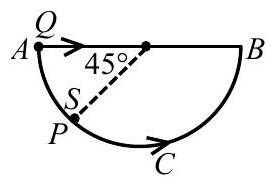
A bead P sliding on a frictionless semi-circular string (ACB) and it is at point S at t=0 and at this instant the horizontal component of its velocity is v. Another bead Q of the same mass as P is ejected from point A at t=0 along the horizontal string AB, with the speed v, friction between the beads and the respective strings may be neglected in both cases. Let tp and tQ be the respective times taken by beads P and Q to reach the point B, then the relation between tp and tQ is
(A)tP>tQ
(B)tp<tQ✓ Correct
(C)tp>1.25tQ
(D)tp=tQ
Answer: (B)
Solution
At S the bead's velocity is tangent to the circle and makes 45∘ with the horizontal, so if its horizontal component is v the speed there is vS=cos45∘v=2v. Bead Q runs along the straight horizontal wire AB with no horizontal force, covering the diameter 2R at the constant speed v, so tQ=v2R. Bead P travels the arc from S to B, which subtends 135∘ and has length 43πR≈2.36R; as it first dips below AB gravity speeds it up, so its speed stays of order 2v or more along the path. Covering a path only a little longer than 2R at an average speed appreciably greater than v, bead P arrives before bead Q: tP<tQ.
JEE Main · 2026 · 23 Jan 2026 · Shift 2 · Single correct option