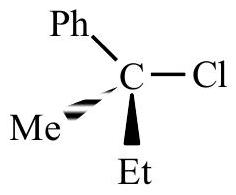
Given below are two statements : Statement I: 'C-Cl' bond is stronger in CH2=CH−Cl than CH3−CH2−Cl Statement II : The given optically active molecule, (see structure) on hydrolysis gives a solution that can rotate the plane polarized light. In the light of the above statements, choose the correct answer from the options given below
(A)Statement I is false but Statement II is true
(B)Both Statement I and Statement II are true
(C)Both Statement I and Statement II are false
(D)Statement I is true but Statement II is false✓ Correct
Answer: (D)
Solution
In CH2=CH−Cl a lone pair on chlorine conjugates with the π bond, giving the C−Cl linkage partial double-bond character, so it is shorter and stronger than the pure single bond in CH3−CH2−Cl; Statement I is correct. The chiral substrate C6H5−CCl(CH3)(C2H5) is a tertiary benzylic halide that hydrolyses by SN1 through a planar carbocation; attack from both faces gives a racemic mixture, which is optically inactive and does not rotate plane-polarised light, so Statement II is false. Statement I is true but Statement II is false.
JEE Main · 2026 · 24 Jan 2026 · Shift 1 · Single correct option