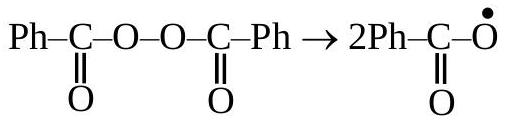
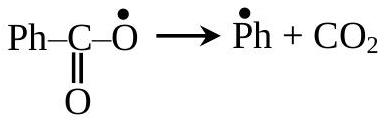
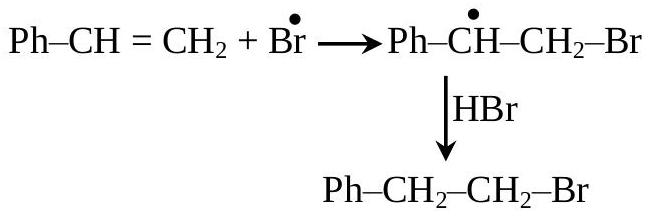
Consider the above reaction A. The reaction proceeds through a more stable radical intermediate. B. The role of peroxide is to generate H˙ (Hydrogen radical). C. During this reaction, benzene is formed as a biproduct. D. 1-Bromo-2-phenylethane is formed as the minor product. E. The same reaction in absence of peroxide proceeds via carbocation intermediate.
Identify the correct statements. Choose the correct answer from the options given below:
(A)A & E Only
(B)A, B & D Only
(C)C, D & E Only
(D)A, C & E Only✓ Correct
Answer: (D)
Solution
With a peroxide, HBr adds to styrene through a free-radical chain. A bromine atom adds to the terminal =CHX2 so that the unpaired electron sits on the benzylic carbon, the more stable radical because it is delocalised into the ring; this anti-Markovnikov orientation makes Ph−CHX2−CHX2−Br the major product. The initiator dibenzoyl peroxide breaks down to phenyl radicals with loss of COX2, and a phenyl radical that abstracts hydrogen from HBr gives benzene as a by-product. Without peroxide the proton adds first to form the resonance-stabilised benzylic carbocation Ph−C+H−CHX3, so the ionic Markovnikov path operates. The correct statements are that the reaction goes through the more stable radical, that benzene is formed as a by-product, and that the peroxide-free reaction proceeds through a carbocation.
JEE Main · 2026 · 28 Jan 2026 · Shift 1 · Single correct option