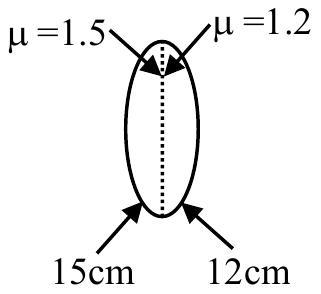
A biconvex lens is formed by using two thin planoconvex lenses, as shown in the figure. The refractive index and radius of curved surfaces are also mentioned in figure. When an object is placed on the left side of lens at a distance of 30 cm from the biconvex lens, the magnification of the image will be :
(A)-2✓ Correct
(B)+2
(C)+2.5
(D)-2.5
Answer: (A)
Solution
The two planoconvex lenses are in contact, so their powers add. From the figure the left curved surface has μ1=1.5, R1=15 cm and the right curved surface has μ2=1.2, R2=12 cm. By the lens maker's formula for a planoconvex lens, f11=(μ1−1)R11=(1.5−1)151=301 and f21=(μ2−1)R21=(1.2−1)121=601. The combination therefore has f1=301+601=201, so f=20 cm. With u=−30 cm, the thin-lens equation gives v1=f1+u1=201−301=601, hence v=60 cm. The magnification is m=uv=−3060=−2, a real, inverted image twice the size of the object.
JEE Main · 2026 · 28 Jan 2026 · Shift 2 · Single correct option