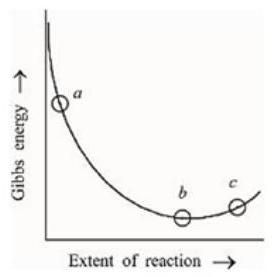
Consider the graph of Gibbs free energy G vs Extent of reaction. The number of statement/s from the following which are true with respect to points (a), (b) and (c) is ______
A. Reaction is spontaneous at (a) and (b) B. Reaction is at equilibrium at point (b) and nonspontaneous at point (c) C. Reaction is spontaneous at (a) and nonspontaneous at (c) D. Reaction is non-spontaneous at (a) and (b)
Answer: 2
Solution
On a plot of Gibbs energy against extent of reaction, the sign of the slope dG/dξ decides the behaviour: a negative slope means the reaction is spontaneous, a zero slope at the minimum means equilibrium, and a positive slope means it is non-spontaneous. Point (a) lies on the descending branch, so the reaction is spontaneous there; point (b) sits at the minimum, so the system is at equilibrium; point (c) lies on the rising branch, so the reaction is non-spontaneous. Testing the statements, the claim that the system is at equilibrium at (b) and non-spontaneous at (c) holds, and the claim that it is spontaneous at (a) and non-spontaneous at (c) holds, while the other two fail. The number of true statements is 2.