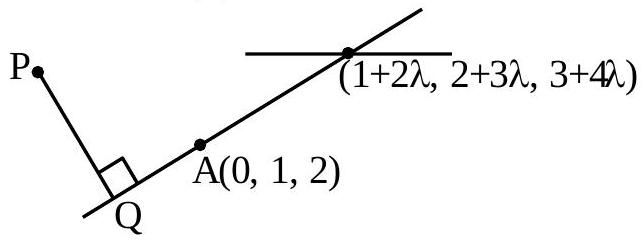
Let the line L pass through the point (0,1,2), intersect the line 2x−1=3y−2=4z−3 and be parallel to the plane 2x+y−3z=4. Then the distance of the point P(1,−9,2) from the line L is
(A)9
(B)54
(C)69
(D)74✓ Correct
Answer: (D)
Solution
Let A=(0,1,2) be the given point on L. The given line can be parametrized as (1+2λ,2+3λ,3+4λ). Let B be the intersection point, so B=(1+2λ,2+3λ,3+4λ). The direction vector of L is AB=(1+2λ,1+3λ,1+4λ). For L to be parallel to the plane 2x+y−3z=4, we need AB⋅n=0 where n=(2,1,−3). Thus 2(1+2λ)+(1+3λ)−3(1+4λ)=2+4λ+1+3λ−3−12λ=−5λ=0, so λ=0. Hence B=(1,2,3) and AB=(1,1,1). The line L has equation r=(0,1,2)+μ(1,1,1), i.e., a general point is Q=(μ,1+μ,2+μ). For the foot of perpendicular from P(1,−9,2) to L, we need PQ⋅AB=0: (μ−1,10+μ,μ)⋅(1,1,1)=(μ−1)+(10+μ)+μ=3μ+9=0, so μ=−3. The foot is Q=(−3,−2,−1). The distance is PQ=(1−(−3))2+(−9−(−2))2+(2−(−1))2=16+49+9=74.
JEE Main · 2023 · 06 Apr 2023 · Shift 2 · Single correct option