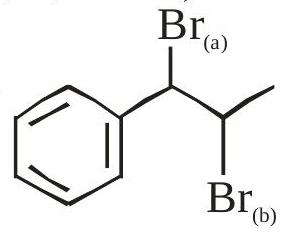
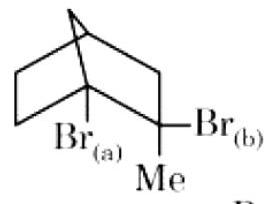
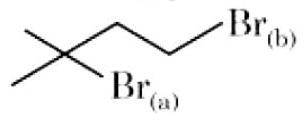
Choose the halogen which is most reactive towards SN1 reaction in the given compounds (A, B, C & D) A. B. C. D.ABCD
(A)A−Br(b);B−I(b);C−Br(b);D−Br(b)
(B)A−Br(a);B−I(a);C−Br(b);D−Br(a)✓ Correct
(C)A−Br(b);B−I(a);C−Br(a);D−Br(a)
(D)A−Br(b);B−I(a);C−Br(a);D−Br(a)
Answer: (B)
Solution
An SN1 reaction proceeds through a carbocation, so within each molecule the halogen that leaves to give the more stable cation is the more reactive one. In A, loss of Br(a) gives a benzylic cation stabilised by the ring, far more stable than the secondary cation from Br(b), so Br(a) is favoured. In B, loss of I(a) gives an allylic cation delocalised over the double bond, whereas I(b) would give an unstabilised primary cation, so I(a) is favoured. In C, Br(a) sits at a bridgehead where a planar cation cannot form, so the non-bridgehead tertiary Br(b) is favoured. In D, Br(a) is on a tertiary carbon while Br(b) is primary, so Br(a) is favoured. The most reactive halogens are therefore A−Br(a), B−I(a), C−Br(b) and D−Br(a).
JEE Main · 2023 · 08 Apr 2023 · Shift 1 · Single correct option