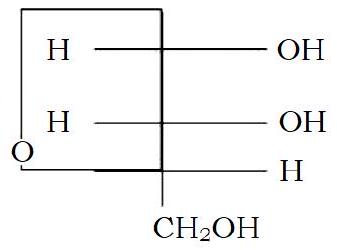
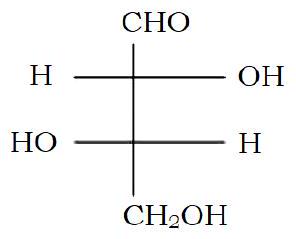
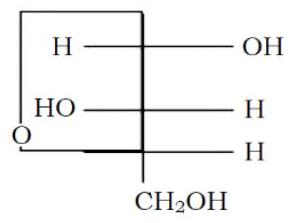
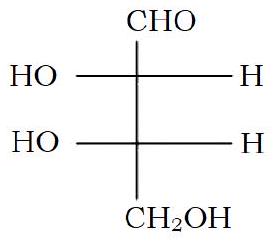
L-isomer of tetrose X(C4H8O4) gives positive Schiff's test and has two chiral carbons. On acetylation. ' X ' yields triacetate. ' X ' also undergoes following reactions ′A′←HNO3 ' X′NaBH4 Chiral compound ’ B′ ' X ' is
(A)(see structure)
(B)(see structure)✓ Correct
(C)(see structure)
(D)(see structure)
Answer: (B)
Solution
The formula CX4HX8OX4 with a positive Schiff's test indicates a free aldehyde group, and formation of a triacetate indicates three hydroxyl groups, so X is the open-chain aldotetrose OHC−CHOH−CHOH−CHX2OH with two chiral carbons. Reduction with NaBHX4 converts the −CHO to −CHX2OH, giving the corresponding tetritol; this product B is chiral only for threitol, since the erythritol from an erythrose would be a meso (optically inactive) compound. Therefore X is a threose, and with the hydroxyl on the lowest chiral carbon drawn to the left it is the L-threose, in which the two secondary hydroxyls lie on opposite sides of the Fischer projection.
JEE Main · 2023 · 11 Apr 2023 · Shift 1 · Single correct option