Students and parents preparing for engineering often first hear the word "CUET" in passing — a senior took it, someone in the neighbourhood got into Delhi University through it — and assume it's something for the humanities and commerce crowd, not for a science student aiming at engineering. That's only half true. CUET is the single entrance test that now decides undergraduate admission to almost every central university in India, and for a certain kind of engineering aspirant, it quietly opens a door that JEE alone does not.
This article lays out what CUET actually is, how the exam is built, and how to think about it — first from an engineering student's point of view, then for every other stream, and finally with a look at the Delhi-NCR colleges that students chase through it.
Note: This article is written to be evergreen, but specific dates, fees, eligibility thresholds, subject lists, and procedural details are set each year by the relevant authority — NTA, the UGC, or the university concerned. CUET has changed its rules more than once in recent years, so always cross-check the latest official notification at cuet.nta.nic.in before acting on anything time-sensitive.
CUET for the engineering student
If your child is preparing for JEE, here is the part most people miss: a few well-regarded engineering programmes in Delhi do not go through JEE at all. They admit through CUET.
The clearest example is Delhi University's own engineering route. DU runs B.Tech programmes — through its Faculty of Technology (offering branches like Computer Science, Electronics & Communication, and Electrical Engineering) and through its Cluster Innovation Centre — and admission to these is based on the CUET score, not JEE. A student sits the CUET with Mathematics as a domain paper (Maths is required, both in Class 12 and as a CUET subject), and DU allocates seats through its own CSAS counselling portal on the basis of that score.
For a Delhi-NCR family, that's worth knowing early, because it means a serious engineering aspirant can keep a genuine, brand-name option open with relatively little extra effort. The CUET domain papers for Physics, Chemistry, and Mathematics are built entirely on the NCERT Class 12 syllabus — which a JEE student is already covering in depth. The exam style is different (we'll come to that), but the content is familiar ground.
A few honest clarifications, because this is exactly where students get confused:
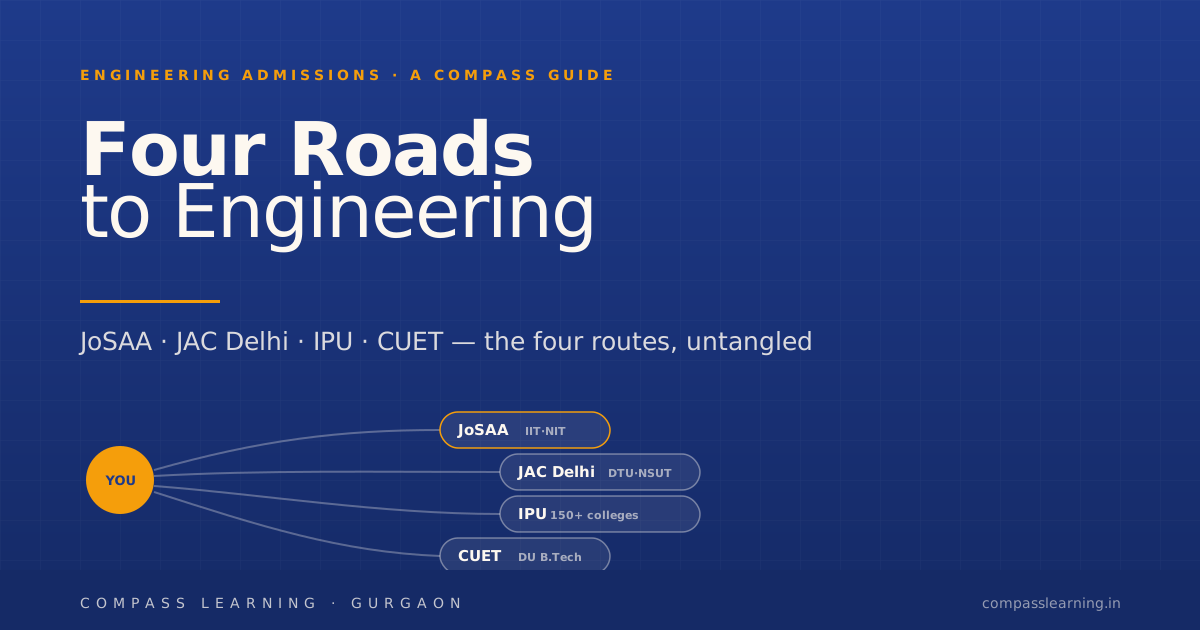
- The big engineering names in Delhi — DTU, NSUT, IIIT-Delhi, IGDTUW — do not admit B.Tech through CUET. They go through JEE Main, and seats are allotted by JAC Delhi (the Joint Admission Counselling that pools these Delhi government institutions into one counselling, with 85% of seats reserved for students who did their Class 11 and 12 in Delhi). So CUET doesn't replace JEE for those. (Delhi's engineering admissions actually run on several separate pathways — JoSAA for the IITs/NITs/IIITs, JAC Delhi for DTU/NSUT/IIIT-D/IGDTUW, IPU's own counselling for GGSIPU colleges, and CUET for DU's programmes. We untangle all of them in How Engineering Admissions Work in Delhi: JoSAA, JAC, IPU and CUET.)
- IITs and NITs don't use CUET at all. JEE Main and JEE Advanced remain the only path there.
- So CUET, for an engineering student, is best understood as an additional door — primarily DU's own engineering programmes — rather than a substitute for JEE. It widens your options; it doesn't change your main preparation.
The practical takeaway: if you're a JEE student and DU's engineering programmes appeal to you, filling the CUET form with PCM domain papers is a low-cost way to add a strong backup. You're already studying the Class 12 syllabus; you mainly need to get used to the CUET format and put in a little focused practice closer to the exam.
What CUET actually is
CUET — the Common University Entrance Test (Undergraduate) — is conducted by the National Testing Agency (NTA). Since 2022, it has become the common gateway for undergraduate admission to all central universities and a large and growing number of state, deemed, and private universities. More than 250 universities now use it.
The idea behind it was simple: instead of every university running its own cut-off race on Class 12 board marks (where a Tamil Nadu board student and a CBSE student were never really being compared fairly), there would be one standardised exam that puts everyone on the same footing. Board percentages no longer decide your college; your CUET score does.
For students, this is a genuine shift. A brilliant student from a board that marks strictly is no longer at a disadvantage against a board that marks generously. The trade-off is that you now have one more important exam to prepare for — and one whose rules you need to understand properly.
How the exam is built
CUET is a computer-based test (CBT), conducted over multiple days and shifts. Because it runs across many shifts, final scores are normalised so that students who sat different shifts (of slightly different difficulty) are compared fairly.
The test is organised into three kinds of papers, and you assemble your own combination from them:
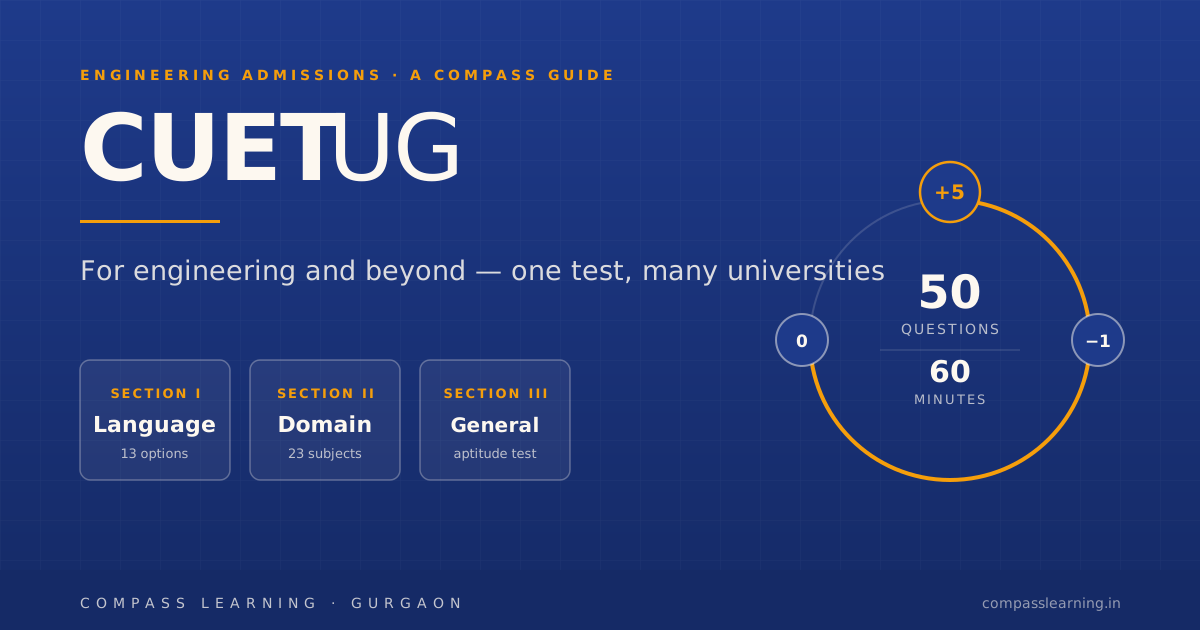
Section I — Languages. Thirteen languages are on offer (English, Hindi, and eleven others including Tamil, Telugu, Kannada, Malayalam, Marathi, Gujarati, Odia, Bengali, Urdu, Assamese, and Punjabi). These papers test reading comprehension and language ability, not literature. You must choose at least one language.
Section II — Domain subjects. These are the academic subjects — Physics, Chemistry, Mathematics, Biology, Accountancy, Business Studies, Economics, History, Political Science, Geography, Psychology, Sociology, and so on. There are 23 domain subjects available. Crucially, since recent rule changes, you may choose any domain subject regardless of what you studied in Class 12 — though you must still meet the subject requirements of whichever university course you're targeting. (For DU engineering, for instance, Maths is non-negotiable.)
Section III — General Test. A single aptitude-style paper covering general knowledge, current affairs, basic numerical ability and quantitative aptitude, logical and analytical reasoning, and general science. Some courses require it; many use it as the basis for admission to programmes whose specific subjects are no longer offered.
In total there are 37 papers to choose from — 13 languages, 23 domain subjects, and 1 General Test. A candidate may select a maximum of 5 papers, including at least one language.
The pattern, paper by paper
Each paper follows the same shape, which makes planning straightforward:
- 50 multiple-choice questions per paper, all compulsory. This is the most important recent change to understand. Earlier, a paper had extra questions and you could choose to attempt, say, 40 out of 50 — which meant you could quietly skip a chapter or two. That option is gone. Now all 50 are compulsory, which means no chapter can be safely ignored. Preparation has to be complete.
- 60 minutes per paper.
- Marking: +5 for a correct answer, −1 for a wrong answer, 0 for unattempted. So each paper is out of a maximum of 250 marks.
- If a question is later dropped or found to have a wrong key, full marks are typically granted to all who attempted it, per NTA's rules that year.
Because of the negative marking, blind guessing hurts. A wrong answer doesn't just fail to earn — it actively costs you a mark. The sensible approach is to attempt what you genuinely know or can reason out, and be cautious with pure guesses.
One detail worth dwelling on
The shift to "all 50 compulsory" changed how CUET should be prepared for. Under the old system, a student could afford to leave out a weak chapter and still attempt a full paper. Now, every chapter of the NCERT Class 12 syllabus is fair game and must be attempted. This rewards students who prepare the whole syllabus evenly and punishes those who bet on selective study. If you take one thing away about CUET strategy, let it be this: cover the entire Class 12 NCERT, not most of it.
Eligibility, in plain terms
- You need to have passed Class 12 (or be appearing for it) from a recognised board. Students currently in Class 12 and sitting their boards are eligible to register.
- There is no upper age limit for the exam itself — though individual universities may apply their own age rules for specific courses.
- There is no cap on the number of attempts. As long as you meet eligibility, you can sit CUET in more than one year.
- Minimum-marks requirements (often around 45% for general category, lower for reserved categories) are set by the universities, not by NTA, and vary by course. Always check the specific course's requirement.
The single most common eligibility mistake: choosing CUET subjects that don't match your target course. A B.Sc. Mathematics programme will expect you to have taken the Mathematics domain paper; a DU engineering seat requires Maths; an Economics (Hons) course may specify Maths or a particular combination. Decide your target courses first, read their subject requirements, and then pick your five papers. Picking subjects you're comfortable with but which your dream course doesn't accept is a heartbreak that's entirely avoidable.
How to prepare for CUET
The good news for a science student is that the domain papers are built on NCERT Class 12 only — Class 11 is not part of the CUET domain syllabus. So the content is narrower than JEE. The challenge is different: CUET rewards accuracy, coverage, and speed on familiar material, rather than the deep multi-concept problem-solving that JEE Advanced demands.
A sensible approach:
- Master the NCERT, cover to cover. Since all 50 questions are compulsory, no chapter is optional. Read the textbook properly, including the lines students usually skim — CUET questions often come straight from NCERT statements.
- Practise the General Test if your course needs it. General knowledge, current affairs, and basic aptitude reward steady, little-and-often preparation over months, not last-minute cramming.
- Take timed mock tests on a computer. CUET is a CBT, and the on-screen interface — question palette, mark-for-review, navigation — is something to be comfortable with before exam day, not on it. Practising on paper alone leaves a gap.
- Watch the clock. 50 questions in 60 minutes is a little over a minute per question. Comfortable, but not infinite — the habit of moving on from a stuck question matters.
- Mind the negative marking. Build the discipline of skipping a genuine blind guess rather than gambling a mark on it.
For a JEE aspirant adding CUET as a backup, the marginal effort is small: you're already deep in the Class 12 syllabus, so the work is mostly about getting used to the CUET format, the compulsory-50 coverage, and a few timed mocks closer to the exam.
CUET for other streams
CUET isn't only an engineering side-door — for commerce and humanities students, it is the main event. The country's most sought-after undergraduate programmes in economics, commerce, the liberal arts, journalism, psychology, and the sciences now run their admissions through it.
The structure is the same three sections, but the subject combinations differ by goal:
- Commerce aspirants (targeting B.Com Hons, BMS, Economics Hons) typically take a language, plus domain papers such as Accountancy, Business Studies, Economics, and Mathematics, and often the General Test.
- Humanities aspirants (targeting Political Science, History, Sociology, Psychology, English) take a language plus the relevant domain subjects, with the General Test where required.
- Science aspirants not heading to engineering (targeting B.Sc. programmes in Physics, Chemistry, Maths, Botany, Zoology, or integrated courses) take a language plus the relevant PCM/B domain papers.
The same golden rule applies to every stream: pick your five papers to match the courses you actually want. Read the eligibility for your target colleges before you choose. And because all 50 questions in every paper are now compulsory, the winning approach across every stream is thorough, even coverage of the full NCERT Class 12 syllabus.
A note on the subjects that were discontinued: a handful of domain papers — among them Entrepreneurship, Teaching Aptitude, Fashion Studies, Tourism, Legal Studies, and Engineering Graphics — have been removed in recent years. Admission to courses tied to those subjects is now handled through the General Test instead. If your target course relates to a discontinued subject, check how that university now expects you to qualify.
The Delhi-NCR colleges students chase through CUET
For Delhi-NCR families, CUET is most exciting because of the institutions it unlocks — a cluster of colleges that have, for decades, been among the most admired in the country. Here are the ones that come up again and again, and what each is known for.
St. Stephen's College
The most storied of Delhi University's colleges. St. Stephen's is known for its Economics, English, History, and Science honours programmes, and a distinctive admissions process that combines the CUET score with the college's own interview. Its alumni list reads like a roll-call of Indian public life. Admission is genuinely competitive, and a strong CUET score is the first hurdle.
Shri Ram College of Commerce (SRCC)
For commerce and economics, SRCC is the most coveted address in India. Its B.Com (Hons) and Economics (Hons) programmes draw the country's strongest commerce students, and the CUET cut-offs here are among the highest anywhere. If your child is a serious commerce aspirant, SRCC is usually the dream — and CUET is the gate.
Lady Shri Ram College for Women (LSR)
LSR is one of the country's leading colleges for the humanities and social sciences — Psychology, Economics, Political Science, Journalism, and Sociology among its celebrated departments. It has a long reputation for academic seriousness and a strong alumnae network. Admission is through CUET.
Hindu College
Hindu College is a perennial top-ranker across the sciences, humanities, and commerce, known equally for academics and a vibrant campus culture. Its Economics, English, History, and Physics honours programmes are particularly sought after, all admitting via CUET.
Hansraj College
Hansraj is a large, highly regarded DU college strong in the sciences (Physics, Chemistry, Botany, Zoology) as well as commerce and humanities. A common target for science students who want a strong B.Sc. through the CUET route.
Miranda House
Consistently ranked among the very top colleges in India in the national rankings, Miranda House (a women's college) is especially strong in the sciences and humanities. Its B.Sc. and BA honours programmes are highly competitive, and admission runs through CUET.
Kirori Mal, Ramjas, Daulat Ram, Gargi, and the wider DU network
Beyond the headline names, Delhi University's larger network — Kirori Mal College, Ramjas College, Daulat Ram College, Gargi College, Sri Venkateswara College, Deshbandhu College, and many more — offers a deep range of honours programmes across streams, all admitting through CUET. For most students, the realistic strategy is to target a spread of these colleges across a range of expected cut-offs, rather than betting everything on one.
Beyond Delhi University
CUET also opens the doors of other major central universities that Delhi-NCR students often consider — Jamia Millia Islamia and Jawaharlal Nehru University (JNU) in Delhi itself, Banaras Hindu University (BHU), Aligarh Muslim University (AMU), the University of Allahabad, and a growing list of state and private universities. Each has its own course strengths and cut-offs, all reached through the same single CUET score.
A few frequently-asked questions
Is CUET only for arts and commerce? No. It admits to science, engineering (notably DU's own B.Tech programmes), commerce, and humanities courses alike across more than 250 universities.
Can I take a subject I didn't study in Class 12? As per recent rules, yes — you may choose any domain subject regardless of your Class 12 stream. But your target course may still require a specific subject (and DU engineering specifically requires Maths in Class 12 as well), so always check the course's eligibility.
How many subjects should I take? Up to five papers, including at least one language. Choose them to match your target courses — no more, no fewer than you need.
Is there negative marking? Yes. +5 for correct, −1 for wrong, 0 for unattempted. Don't gamble blind guesses.
Is the syllabus the same as my board? The domain papers are based on the NCERT Class 12 syllabus, so there's heavy overlap with CBSE and aligned boards — but the question style is different, and all 50 questions per paper are compulsory, so complete coverage matters.
Where to read next
For the bigger admissions picture, including how CUET fits alongside the engineering entrance exams: JEE, BITSAT and Beyond: A Complete Guide to Engineering Admissions in India.
Have questions about your specific situation?
We're at Ardee City, Sector 52, Gurgaon. Drop by anytime, or give us a call. Always happy to chat through strategy with parents and students — no pitch, no pressure, just a conversation about what makes sense for you.