When parents start reading about engineering admissions, they encounter two related terms that mean different things and are often used interchangeably: cutoff and closing rank. Reading them right is essential before you sit down to fill JoSAA choices. This article walks through what each one means, where to find the data, how to read trends across years, and how to use it all to plan a realistic choice list — including a note on the various counselling-help apps that have appeared in recent years.
Note: This article is written to be evergreen, but specific dates, fees, eligibility thresholds, and procedural details are set each year by the relevant authority — NTA, JoSAA, BITS Pilani, HSTES, or the institute concerned. Always cross-check the latest official notification before acting on anything time-sensitive.
Two related but different things
Cutoff has two meanings depending on context.
In the first sense, an "exam cutoff" or "qualifying cutoff" is the minimum score or percentile above which a candidate is eligible for the next stage. For JEE Main, NTA announces qualifying cutoffs each year for different categories — these determine who's eligible to write JEE Advanced. For JEE Advanced, IIT announces minimum aggregate and subject-wise cutoffs for ranking.
In the second sense — the one most parents encounter during counselling — "cutoff" is used as shorthand for closing rank: the lowest rank at which a seat was allotted in a particular institute-branch-category combination.
When a senior says "the cutoff for NIT Trichy CSE was around AIR 1300 last year", they mean closing rank — the rank at which the last seat for CSE in the Open category at NIT Trichy was filled.
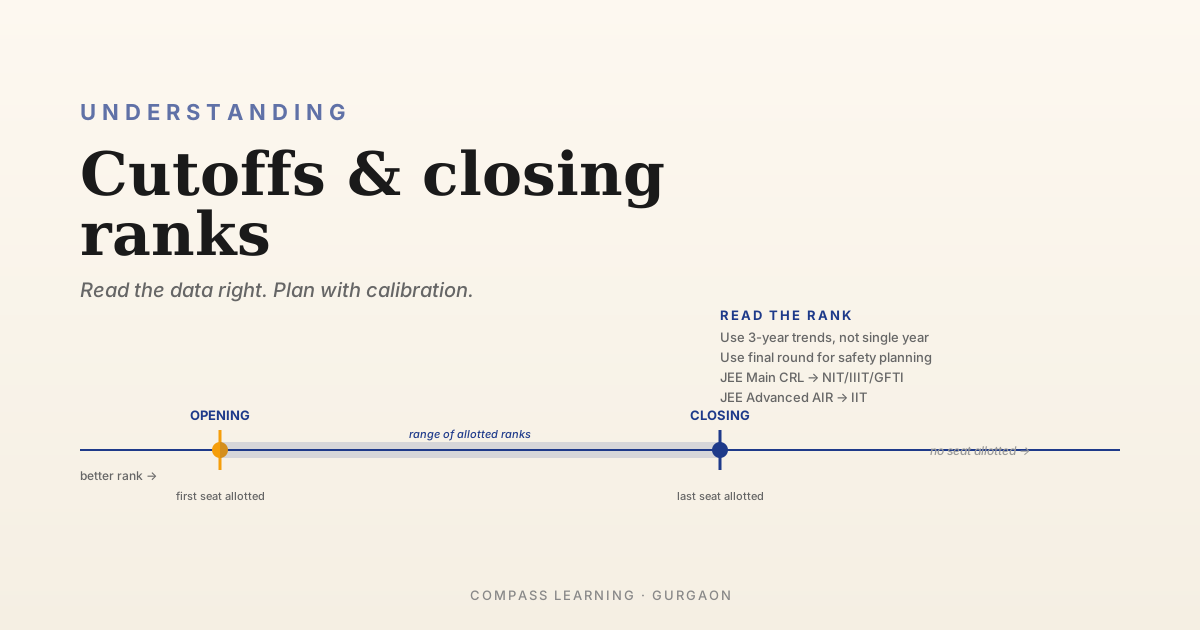
Opening rank is the corresponding pair to closing rank: it's the rank of the first candidate admitted to that institute-branch-category combination. So a row of JoSAA data has both — the highest-ranked candidate admitted (opening) and the lowest-ranked (closing). The gap between them tells you the range of ranks that found seats there.
What the numbers actually tell you
A closing rank is essentially a historical record of demand. If NIT Trichy CSE's closing rank in 2025 was around CRL 1300, it means seats were allotted up to that rank, and any candidate with a worse rank than that didn't get into NIT Trichy CSE that year.
A few important nuances:
The closing rank moves between rounds. JoSAA conducts six rounds (typically). Round 1 closing ranks are tighter — fewer seats have moved, fewer candidates have upgraded. By Round 5 or 6, the closing rank usually loosens as candidates with better ranks accept seats elsewhere (other IITs, BITSAT, private universities, drop year, etc.). For planning your safety options, the final round closing rank is the relevant benchmark.
Closing ranks differ by category. Open category cutoffs are the strictest. OBC-NCL, SC, ST, EWS, PwD categories each have their own closing ranks, usually relaxed (numerically higher) compared to Open.
Closing ranks differ by quota at NITs. Each NIT splits its seats between Home State (HS) — for students from the state where the NIT is located — and Other State (OS) — for everyone else. Home State closing ranks are typically much more relaxed than Other State for the same branch. For a Gurgaon student looking at NIT Kurukshetra, they'd be in the Home State quota (Haryana domicile); for NIT Trichy or Surathkal, they'd be Other State. This makes a meaningful difference — a 20,000–40,000 rank gap between HS and OS for the same branch isn't unusual.
Closing ranks differ by gender pool at IITs and some NITs. A few years ago, the system introduced a Female-only supernumerary pool to improve gender representation at IITs. These seats have their own (usually more relaxed) closing ranks. A female candidate is eligible for both the Gender-Neutral pool and the Female pool, and JoSAA gives her the better outcome.
JEE Main rank vs JEE Advanced rank. The two rank lists are completely separate. NIT, IIIT, and GFTI cutoffs use JEE Main CRL (Common Rank List). IIT cutoffs use JEE Advanced AIR. Confusing them is a common error — a JEE Main rank of 1500 and a JEE Advanced rank of 1500 are two different things, and they map to different institutes.
Where to find the data
The authoritative source is the JoSAA portal itself at josaa.nic.in. After each round of counselling, JoSAA publishes the opening and closing rank data for every institute-branch-category-quota-pool combination. The data is downloadable as a PDF or browsable in a query interface.
For historical trends, JoSAA archives data from previous years on the same portal. Looking at the last three years (rather than just one) is the better practice — single-year data can be misleading if there was an unusual factor that year (exam difficulty, paper-leak rumour, particular result distribution, etc.).
For HSTES, the Haryana counselling, similar data is available at hstes.org.in. For BITSAT, BITS publishes the cutoffs in terms of marks (not ranks, since BITSAT isn't a percentile system).
Counselling apps and predictors
In recent years, a number of apps and platforms have emerged that offer help with counselling. They generally fall into two categories: rank-based predictors that estimate your chances of admission to specific colleges, and mentorship platforms where current college students answer queries from incoming aspirants.
A few honest observations about these tools:
Predictors are heuristics, not guarantees. They typically use the past two to three years of closing ranks — the same data that is freely available on the JoSAA portal — to estimate your chances. The estimate is useful as a sanity check ("is this college realistic for my rank?") but the actual seat allocation depends on factors no predictor sees: the specific cohort competing in your year, the number of seats added or removed, students opting for IITs over NITs in unexpected patterns, and others.
The official data is free. Anyone selling "exclusive cutoff data" is repackaging what is already available at josaa.nic.in. The value, where there is one, lies in the presentation — clean tables, trend charts, search filters. Whether that is worth a fee is a personal call.
Mentorship-based platforms can be genuinely useful — especially for understanding what a college is actually like (placements, culture, hostel life, faculty) from a student currently studying there. The human element adds something an algorithm cannot.
Be cautious of anything promising guaranteed outcomes. No counselling service can guarantee a seat. Treat marketing that suggests otherwise with healthy scepticism.
If you do use any of these tools, treat them as one input to your decision-making, not a substitute for it. The choice list you submit to JoSAA is yours; the tools can inform it but should not write it.
How to use cutoff data — a small framework
When you sit down with the cutoff data for the first time, here's a workable approach:
Step 1: Identify your rank zone. Take your JEE Main CRL (or JEE Advanced AIR, depending on which counselling you're in). Add a buffer of about 10–15% above and below — this is the zone you'll seriously consider.
Step 2: Build three tiers.
- Aspirational — institutes where the closing rank for your preferred branch is better than your rank (you're at the harder end). These are the seats you want if the round goes well.
- Realistic — institutes where the closing rank is in your zone. These are where most of your seat probability sits.
- Safety — institutes where the closing rank is comfortably worse than yours (you're well within range). These ensure you get some seat.
Step 3: For each tier, list multiple branches and institutes. You're not limited to one row per institute. NIT Trichy alone has many branches; you can include CSE, ECE, EE, Mechanical, Chemical, and Metallurgy each as separate preferences with their own closing ranks.
Step 4: Order the full list by genuine preference. This is the key principle from the JoSAA Counselling Process article — order by what you'd want most, not by what you think you'll get. The algorithm allocates the highest-listed choice your rank reaches, so putting realistic above aspirational doesn't help.
Step 5: Look at three years of data, not one. If a branch's closing rank has been tightening (numerically lower) over three years, expect competition. If it's been loosening or stable, your buffer is more reliable.
Some patterns visible across years
A few things that show up in three-year cutoff data and are worth knowing:
- Computer Science cutoffs at top NITs have been tightening year-over-year, reflecting the increasing preference for CS over older branches. The gap between CS and Mechanical at the same NIT has widened.
- IIT Bombay CSE remains the tightest cutoff in the country — closing ranks have stayed in the AIR 60–70 range across recent years for Open category Gender-Neutral pool.
- Newer IITs and IIITs sometimes see surprising movements — a new IIT in its first few years may have looser cutoffs than its later position would suggest. Conversely, an IIIT that gains a reputation can see cutoffs tighten quickly.
- Female-only pool cutoffs at IITs are generally more relaxed than Gender-Neutral, though the gap is narrowing as more female candidates aim for top institutes.
The honest limitation of all cutoff data
Cutoffs describe the past. They're the best available indicator of the present, but they're not the present. Each year:
- The exam difficulty can shift the rank distribution.
- The number of candidates competing changes.
- New institutes or new branches get added.
- Reservation rules can change.
- Student preferences shift over time (e.g., the move toward CS, the recent rise of AI/ML specialisations).
The right way to use cutoffs is as a calibration, not a prophecy. Plan with them, choose wisely, and accept that the final allotment will surprise you in some way — usually a pleasant one if you've filled enough choices.
Where to read next
For the counselling mechanics: JoSAA Counselling Process: How IIT, NIT and IIIT Seats Are Allocated.
For the leftover rounds: CSAB Special Rounds: Who Gets a Second Chance (coming soon).
For the bigger picture: JEE, BITSAT and Beyond: A Complete Guide to Engineering Admissions in India.
For the Haryana track: Engineering Colleges in Haryana: Admission, Counselling, and a Local Guide for Gurgaon Students.
Have questions about your specific situation?
We're at Ardee City, Sector 52, Gurgaon. Drop by anytime, or give us a call. Always happy to chat through strategy with parents and students — no pitch, no pressure, just a conversation about what makes sense for you.