Exam day arrives suddenly. A year of preparation, two months of revision, two weeks of final sharpening — and then a Wednesday morning when the alarm rings at 6 a.m. and the question is no longer "what's the syllabus" but "is the admit card printed". This article walks through the practical details of JEE Main exam day — what to carry, what to wear, what to expect at the centre, and the small mistakes that have caught careful students in the past.
We've kept this evergreen, but please cross-check with the latest official advisory from NTA — they sometimes tighten or relax a rule, and the admit card itself carries the binding instructions.
Note: This article is written to be evergreen, but specific dates, fees, eligibility thresholds, and procedural details are set each year by the relevant authority — NTA, JoSAA, BITS Pilani, HSTES, or the institute concerned. Always cross-check the latest official notification before acting on anything time-sensitive.
What to carry — the short list
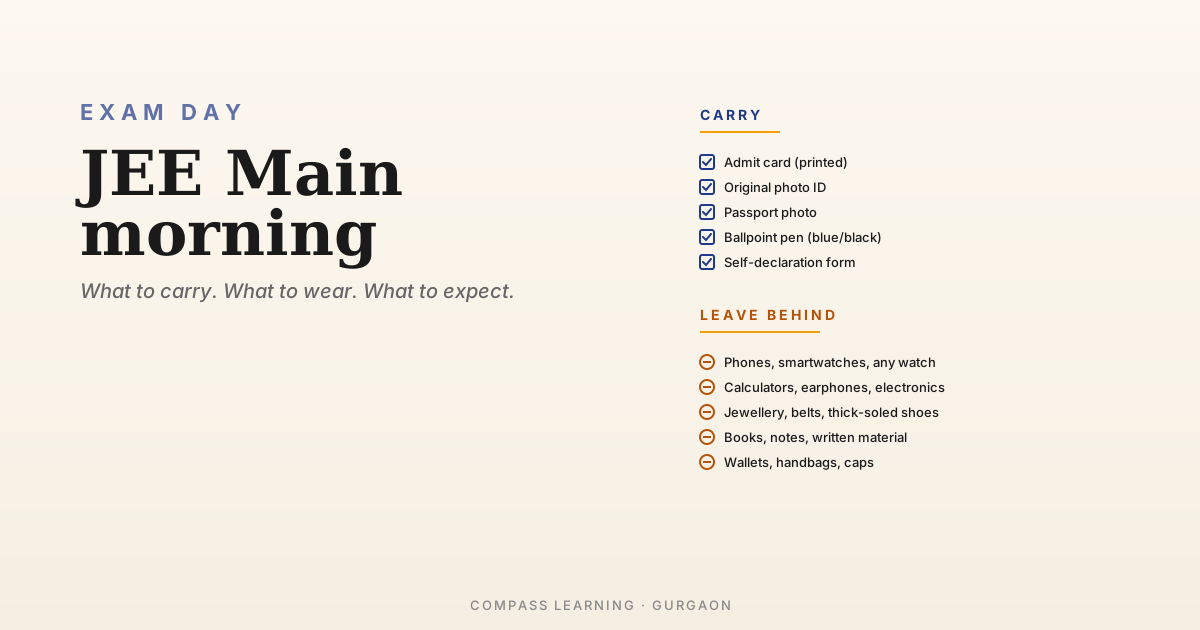
There are exactly five things you need at the centre:
- Admit card — printed, clear, on a single A4 sheet. Two copies is safer than one.
- One original photo ID — Aadhaar is the standard. If your Aadhaar doesn't have the candidate's photo clearly visible, an alternative ID like passport, voter ID, PAN, or a school ID with photograph works. The ID name must match the admit card name.
- One passport-sized photograph — the same photograph you uploaded in the application form. Glue it to the space provided on the admit card (or attendance sheet, depending on the centre's protocol).
- A simple blue or black ballpoint pen — sometimes provided at the centre, but carry one. Gel pens, fountain pens, and ink pens are not allowed.
- A self-declaration form — printed and filled, if the admit card mentions it for that year. The form is usually downloadable from the NTA portal alongside the admit card.
For PwD candidates, the disability certificate is also required.
That's the entire list. Nothing else.
What not to carry
This is the longer list and the more important one. The following items are prohibited inside the exam hall:
- Mobile phones, smartphones of any kind
- Smartwatches, digital watches, analog watches — no watches at all
- Calculators of any type, including scientific calculators
- Earphones, Bluetooth devices, fitness bands
- Logarithm tables, slide rules, books, notes, written or printed material of any kind
- Wallets, handbags, pouches — keep money and valuables to a minimum
- Geometry or pencil boxes, pens or pencils brought in cases
- Eatables, except as specifically permitted for diabetic candidates
- Water bottles — most centres provide water inside
- Caps, scarves, stoles, mufflers
- Jewellery, ornaments, rings, bracelets, earrings
- Belts with metal buckles
- Hair clips with metallic elements
There are usually no proper storage facilities at the centre. The best practical approach: leave everything behind at home or with a parent waiting outside. Take only what you need.
Dress code
There's no formal uniform, but the dress code restrictions are real:
- Light, simple clothing. Plain T-shirts or half-sleeve shirts work well for boys; plain salwar-kameez or kurtis for girls. Avoid clothes with large metal buttons, embellishments, or zips.
- Open footwear preferred. Slippers or open sandals are recommended. Closed-toe shoes — especially shoes with thick soles — can cause delays at the security check. Some centres ask candidates to remove closed shoes entirely.
- No layered clothing. Avoid jackets, hoodies, full-sleeve thermal wear. If the weather requires layering, plan a light cardigan you can remove if asked.
- No accessories. No watches, no jewellery, no decorative items.
- Religious articles — Sikh candidates are allowed to wear the Kara (steel bracelet) and Kirpan. Hijab is permitted. Candidates wearing religious attire are advised to reach the centre earlier so that any additional security check doesn't delay seating.
The reasoning is consistent across all these rules: anything that can hide an electronic device, anything that delays metal detector screening, and anything that gives an unfair advantage is removed. Light clothing speeds you through security and gets you to your seat unhurried.
Reporting time
The admit card mentions a specific reporting time, which is typically 90 minutes to 2 hours before the exam start. So for a 9 a.m. exam, the reporting time is usually 7:30 a.m.; for a 3 p.m. exam, 1:30 p.m. or 1 p.m.
Reach earlier than the reporting time. Specifically:
- For a morning exam: aim to be at the centre by 7 a.m., even if reporting begins at 7:30. Delhi NCR traffic in particular is unpredictable on weekday mornings, and being 30 minutes early lets you breathe.
- For an afternoon exam: aim to be at the centre by 12:30 p.m. for a 3 p.m. exam.
Once at the centre, the sequence is usually:
- Verification of admit card and ID at the entrance.
- Frisking and metal detector check.
- Biometric verification — in recent years, NTA has been using Aadhaar-based biometric authentication. A fingerprint scan confirms your identity.
- Photo capture for the attendance record.
- Allocation to your seat in the exam hall.
The whole process can take 30–45 minutes when crowds build up. Reporting late even by a few minutes risks missing entry — NTA's rules state that the gates close at a specific cut-off time, and once closed, no entry is permitted.
Inside the exam hall
The exam is computer-based. At your seat you'll find:
- A computer screen and mouse (no keyboard input except for numerical-value questions)
- A few sheets of rough paper for calculations
- A pen (sometimes provided; carry your own as backup)
- A clock visible in the exam hall — no personal watches
The standard pattern: a brief mock test or interface tutorial appears first, then the actual paper begins. Use the tutorial to familiarise yourself with the navigation — the system is straightforward but seeing it once before the timer starts on the real paper is reassuring.
A few things to know:
- Question navigation. You can move between questions freely. Mark questions for review and come back. Unattempted questions are shown in one colour, attempted in another, marked-for-review in a third.
- No automatic submission warning. When the clock runs out, the paper submits automatically. There's no "are you sure" prompt — what's saved is what's saved.
- Rough sheets. Use them. Write the question number alongside your working. If you need more sheets, raise your hand and ask the invigilator.
- No going back to confirm. After the exam is submitted (either by you or automatically at time-up), you cannot return to view your responses. You'll see only a summary.
During the exam — small practical advice
A few patterns worth being aware of:
- The first 5 minutes are usually disorienting. A new screen, a new chair, a new room, the weight of a year of prep all crashing in. Read the first question slowly. Do one easy question first to settle in.
- Time management is more critical than in school exams. Three hours, 75 questions, almost 2.5 minutes per question on average. If a question is taking more than 4–5 minutes, mark it for review and move on.
- Submit before the clock if everything is reviewed. There's no bonus for finishing early, but there's also no benefit to staring at a submitted screen with three minutes left. Submitting when you're done releases the mental load.
- The toilet break. Permitted, but you'll be frisked again on return. Use it only if necessary, and as early in the paper as possible to avoid losing time in the final stretch.
After the exam
A few things to know about the immediate aftermath:
- Question paper download — NTA typically releases the question papers (in PDF) about a week after the exam, along with the provisional answer key.
- Objection window — for a few days after the answer key release, you can submit objections to specific answers, with a fee per objection (refunded if your objection is upheld). The final answer key is released after this.
- Results — typically 2–3 weeks after the exam.
In the days between the exam and the result, the best advice is also the most under-followed: rest. The brain has done a lot of work. Watching speculative answer-key videos, calculating projected percentiles, and worrying do not change the result. Sleep, eat, do something pleasant. If Session 2 is coming, the rest matters even more.
Diabetic candidates and other medical conditions
NTA permits diabetic candidates to carry specific items that are otherwise prohibited:
- Sugar tablets or fruit (orange, banana, apple)
- Transparent water bottle
- A snack of small size, openly visible
These are subject to centre confirmation, and the rule is to bring such items in transparent packaging that can be visually inspected at the security check. If you have any medical condition, it's worth mentioning at the security gate so they can accommodate appropriately.
What parents should know
A few things that often help on the morning of the exam, from the parent's side:
- Drive the student to the centre. Don't put them in a position of figuring out an Ola or auto on the morning. Reduce decisions.
- Reach 30 minutes earlier than reporting time. Wait outside the centre with them in the car or just outside the gate. Calm conversation is more useful than last-minute advice.
- Don't ask "are you ready?" They are or they aren't. The question doesn't help. Better: "I'll be right here. Take your time when you come out."
- Don't quiz them after. Whatever happened, happened. Saving the debrief for the evening, after they've rested, is much better than a car-ride post-mortem.
A practical evening-before checklist
Run through this the night before the exam:
- Admit card printed (two copies)
- Original photo ID kept ready
- One passport-sized photograph kept ready (same as application)
- Self-declaration form filled (if applicable)
- Two blue/black ballpoint pens
- Outfit laid out — light, simple, no metal
- Open footwear ready
- Wallet, phone, watch, jewellery — set aside, will not be carried
- Exam centre confirmed on map, route planned
- Alarm set for at least 90 minutes earlier than reporting time
Where to read next
For the form-filling step: How to Fill the JEE Main Application Form: A Step-by-Step Guide.
For the documents: JEE Main and Engineering Entrance Documents: The Complete Checklist.
For what JEE Main actually tests: JEE Main Complete Guide.
For the bigger picture: JEE, BITSAT and Beyond: A Complete Guide to Engineering Admissions in India.
Have questions about your specific situation?
We're at Ardee City, Sector 52, Gurgaon. Drop by anytime, or give us a call. Always happy to chat through strategy with parents and students — no pitch, no pressure, just a conversation about what makes sense for you.