Ashoka University: A Liberal Arts University with a Computer Science Pathway — How to Think About It for Engineering Aspirants
A different kind of choice for engineering-leaning students
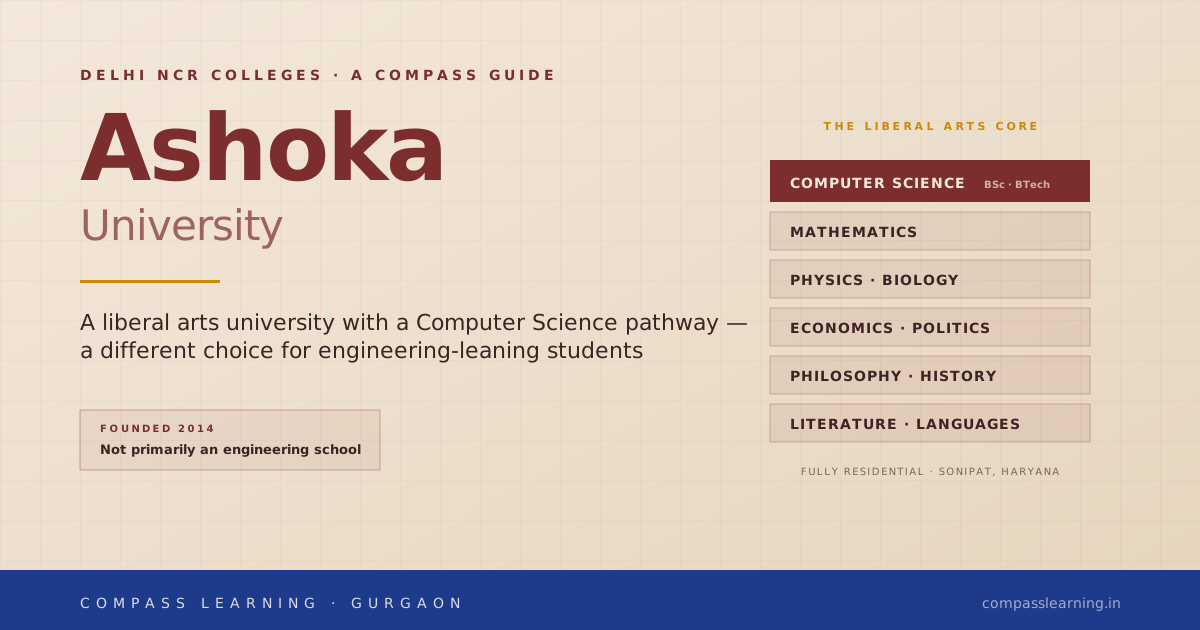
Ashoka University, founded in 2014 at Sonipat in Haryana, is not primarily an engineering institute. It is a liberal arts and research university — built around the model of leading American liberal arts colleges — with strong programs in economics, history, philosophy, English, mathematics, biology, physics, and computer science. In recent years it has added more structured undergraduate programs in computer science, including a BTech in Computer Science.
This is a relevant article for engineering aspirants because a growing number of Gurgaon families are considering Ashoka for students who have strong academics but aren't certain they want a traditional engineering career. The fit at Ashoka is genuinely different from the fit at DTU, NSUT, SNU, or Bennett — and that difference is what this article tries to clarify.
Note: This article is written to be evergreen, but specific dates, fees, eligibility thresholds, and program details are set each year by the university. Always cross-check the latest official notifications before acting on anything time-sensitive.
About the university
A few things to understand about Ashoka's structural identity:
- It is a liberal arts university first. The flagship academic offerings are undergraduate degrees in liberal arts, sciences, and economics. Engineering and computer science are real but smaller parts of the picture.
- It is selective at the cohort level. Total undergraduate intake is small (around 1,000-1,200 students across all disciplines each year), and admissions are competitive.
- It is fully residential. All undergraduates live on the 25-acre campus at Sonipat for the duration of the degree.
- It is research-oriented. Faculty members are predominantly PhD-holders from leading global universities; classes are small; the academic style is discussion-based and rigorous.
- It has substantial financial aid. Ashoka's need-based aid program is among the most generous in Indian higher education, with full aid available for qualifying students.
The university was founded by a collective of Indian philanthropists explicitly to create a top-tier liberal arts institution in India. The vision shapes everything — including how it approaches computer science and engineering.
Relevant programs for engineering aspirants
For students who would otherwise consider a BTech, the relevant Ashoka offerings are:
- BSc (Hons) in Computer Science — a three-year science degree with possibility of a fourth year (Honours / Advanced research)
- BTech in Computer Science — a four-year engineering programme, added more recently
- BSc (Hons) in Mathematics — for students drawn to applied math, often paired with computer science minors
- BSc (Hons) in Physics, Chemistry, Biology — for students interested in natural sciences
The Computer Science department at Ashoka has a strong academic reputation. The BTech program is newer; the BSc (Hons) CS program has a longer track record. Both result in computing-capable graduates, but the BSc is more research-and-grad-school-oriented while the BTech aligns more closely with traditional engineering education.
How admissions work
Ashoka's admissions process is unlike traditional engineering colleges:
- Entrance: Ashoka Aptitude Test (AAT), or SAT scores
- Class XII boards: Considered as part of holistic review
- JEE Main: Sometimes accepted as supporting evidence but is not the primary admission criterion
- Application: Essays, recommendations, extracurriculars — Ashoka uses a holistic admissions model similar to US universities
- Interviews: May be conducted for shortlisted candidates
The holistic model means a student with a strong all-round profile but moderate JEE Main score has a real chance here in a way they wouldn't at a JoSAA-based institution. Conversely, a student with strong JEE Main alone but a thin profile elsewhere may find Ashoka's process harder than expected.
Admission rates are competitive — historically around 10% of applicants are admitted.
Campus, hostel, and student life
The Sonipat campus (around 25 acres, with adjacent grounds for sports and expansion) is purpose-built and architecturally distinctive:
- Hostels: Fully residential, with mixed-cohort hostels across all disciplines
- Academic facilities: Modern classrooms, library, research labs, study spaces, art studios
- Sports: Cricket and football grounds, courts, gym facilities
- Student life: Very active club culture — debate, theatre, music, film, dance, journalism, entrepreneurship, social impact
- Annual events: Banjara (cultural fest), academic conferences, regular speaker events featuring scholars and public figures
The Ashoka campus culture is distinctly different from a traditional engineering college. There is high intellectual intensity — students debate at meals, write for student publications, organise discussions on philosophy and politics. The peer environment is selective and engaged; this matters for some students and may not suit others.
Outcomes and post-graduation paths
This is where Ashoka diverges most sharply from traditional engineering colleges. Ashoka graduates don't primarily go into entry-level engineering jobs at IT services companies. Their trajectories typically include:
- Grad school: Many CS and Math graduates go on to MS or PhD programmes at top US and European universities (CMU, Stanford, MIT, Princeton, ETH, Oxford, Cambridge, etc.)
- Consulting and finance: McKinsey, BCG, Bain, Goldman Sachs, top investment banks
- Research roles: At academic institutions, think tanks, research labs
- Tech industry: Microsoft, Google, Amazon, and major Indian and international product companies — but often via somewhat different recruiting pipelines than DTU/NSUT
- Entrepreneurship and unconventional paths: Significant share of graduates start ventures or take roles at impact organisations, media, public policy
For students who measure "good college choice" by "package offered at campus placement", Ashoka's headline numbers will look different from DTU or NSUT — partly because a significant fraction of Ashoka CS graduates choose grad school over immediate jobs, partly because the recruiter mix is different. Average packages for CS graduates who do enter the workforce directly are typically ₹15-25 LPA.
For students who measure good college choice by "where do graduates end up five to ten years later", the Ashoka trajectory is competitive with top engineering colleges — particularly for students drawn to grad school, research, or non-traditional paths.
Fees and financial aid
Ashoka's fee structure is among the highest in Indian higher education:
- Tuition + academic charges: ~₹10-11 lakh per year
- Hostel + mess: ~₹2-3 lakh per year
- Four-year total: typically ₹45-55 lakh including hostel
This is significantly more than any of the other engineering options. The fee structure reflects Ashoka's positioning as a premium private liberal arts institution.
Financial aid changes the picture substantially. Ashoka's need-based financial aid program is unusual in India — full aid (covering tuition + hostel + mess + some living expenses) is available for students whose families qualify, and partial aid is available for a wider range of family income levels. The aid is calculated based on documented family income and is offered alongside admission, not as a separate process.
If your family income is under ~₹15-20 lakh per year, full aid is realistic depending on circumstances. If income is in the ~₹25-50 lakh range, substantial partial aid is common. Above that, students typically pay full or near-full fees.
For families considering Ashoka, going through the financial aid application during admissions is essential — the sticker price often differs dramatically from what families actually pay.
For Gurgaon students specifically
Ashoka is in Sonipat (Haryana), about 70-90 km from Gurgaon depending on the starting point:
Commute:
- By road: ~75-100 minutes via Outer Ring Road → NH-44, traffic-dependent
- Reality check: Daily commute is not realistic; Ashoka is residential by design
Residential expectation: Plan for hostel from day one. The Ashoka experience is deeply residential — much of the intellectual and social life happens in dorms, late-night discussions, and weekend events. Commuting would mean losing most of what makes the place distinctive.
Alumni in Gurgaon: Ashoka's alumni base is growing rapidly. The first batch graduated in 2017, so the cumulative alumni network is still under a decade old, but the placement of graduates in Gurgaon-based consulting, finance, and tech firms is real and meaningful.
What to know before committing
A few items to weigh carefully:
- It is not a traditional engineering school. The "BTech in CS" is a relatively new offering; the longer-established programme is the BSc (Hons) in CS. If your primary identity is "engineer" and you want a four-year engineering immersion, Ashoka's interdisciplinary culture may feel like a distraction rather than a feature.
- The market reception of an Ashoka CS degree varies. Top-tier consulting, finance, and global tech recognise Ashoka well — often as a strong signal. Indian IT services and traditional engineering employers are more variable in their recognition of Ashoka vs DTU/IIIT Delhi. For a student aiming at Goldman Sachs or McKinsey, this is fine; for a student aiming at TCS or Infosys, it can be less efficient than a traditional engineering college.
- The cost is real even after aid. Full aid is meaningful but not universal. For families above the aid thresholds, the four-year cost is substantially higher than any other option in this guide.
- The liberal arts requirement is not optional. All Ashoka students, including CS majors, complete a core curriculum in liberal arts — literature, philosophy, history, sciences. This is a defining feature, not a peripheral one.
Is Ashoka the right fit?
The university is a strong fit if:
- You are drawn to computer science but unsure if you want a pure engineering career — and you value a broader academic foundation
- You are seriously considering graduate school (MS/PhD) abroad after undergrad
- You qualify for substantial financial aid that makes the cost workable for your family
- You thrive in small-cohort, discussion-heavy academic environments
- You are interested in trajectories beyond traditional engineering — consulting, research, policy, entrepreneurship
The fit is less clear if:
- You want a structured engineering education leading to standard product-company or IT-services placement — a traditional BTech is more efficient for that path
- The fee structure is unworkable even with aid
- You prefer a clearer professional pipeline and are uncertain about non-traditional paths
- You want a large campus with extensive engineering-specific infrastructure
Ashoka is a real option for engineering-leaning students who want a different kind of undergraduate education. It is not a substitute for a traditional engineering college — it is an alternative path that produces different (sometimes better, sometimes harder-to-place) graduates depending on what they want to do.
If you're thinking through engineering admissions and want to talk it through, we're at Ardee City, Sector 52, Gurgaon. Drop by anytime — a fifteen-minute conversation is usually enough to start clarifying which direction makes sense for you.
For more on how admissions, counselling, and college choice fit together, see our full Engineering Admissions Roadmap.