IIIT Delhi: Admissions, Branches, Cutoffs, and Life Inside a Computer-Science-First University
Why IIIT Delhi gets mentioned in the same breath as the IITs
For students serious about computer science, IIIT Delhi is one of the most carefully chosen names on a JoSAA preference list. The institute is small, urban, academically demanding, and almost entirely computing-focused — and over the last fifteen years it has built a reputation strong enough that students often turn down IIT branches in mechanical or civil engineering to take a CS or CS-variant seat here instead.
That choice tells you something about how the institute is perceived. This article walks through what IIIT Delhi actually is, how admissions work, what the branches look like, what life on the Okhla campus is like, and how to think about whether it fits.
Note: This article is written to be evergreen, but specific dates, fees, eligibility thresholds, and cutoff numbers are set each year by the institute, JoSAA, and the Government of Delhi. Always cross-check the latest official notifications before acting on anything time-sensitive.
About the institute
IIIT Delhi (Indraprastha Institute of Information Technology Delhi) was founded in 2008 by the Government of Delhi as an autonomous state university. The campus sits in Okhla Industrial Area Phase III, in south Delhi — about thirty kilometres from the main residential areas of Gurgaon, depending on where you start from.
A few things make IIIT Delhi structurally different from other engineering institutes in India:
- It is small. BTech intake is around 250-300 students per year. That is a fraction of what DTU, NSUT, or any IIT admits. The result is a tight cohort where students know each other across batches.
- It is almost entirely a computing institute. Apart from Electronics and Communication Engineering and a VLSI program, every undergraduate branch is built around computer science.
- It runs at PhD-level research intensity. Many faculty members hold positions at international labs in their off-cycle; research output per professor is high; and undergraduate students are expected to engage with research from early semesters.
If you walk through the campus on a regular day, the vibe is closer to a graduate research institute than a traditional engineering college. That tone carries through to coursework, examinations, and even the way internships and projects are evaluated.
How admissions work
The admissions process is straightforward in structure, though competitive in practice:
- Entrance exam: JEE Main only. IIIT Delhi does not require JEE Advanced — you can be admitted on your JEE Main rank.
- Counselling: Admissions happen through JoSAA, the central counselling system that allocates seats across IITs, NITs, IIITs, and GFTIs. (See JoSAA Counselling Explained for how that process works end-to-end.)
- Eligibility: Class XII with Physics, Chemistry, and Mathematics. Minimum percentages are typically 75% for general category and 65% for reserved categories — but these thresholds are set per cycle, so verify.
- Domicile reservation: This is the most important structural feature to understand. 50% of seats are reserved for Delhi domicile candidates; 50% are open to outside-Delhi candidates. This means cutoffs are very different for the two pools — outside-Delhi cutoffs are significantly tighter because there are fewer seats available.
If you are from Gurgaon (Haryana) and don't have Delhi domicile status, you are in the outside-Delhi pool. Don't assume the headline cutoff number applies to you — check the outside-Delhi closing rank specifically for the branch you want.
The branches: a CS-centric philosophy
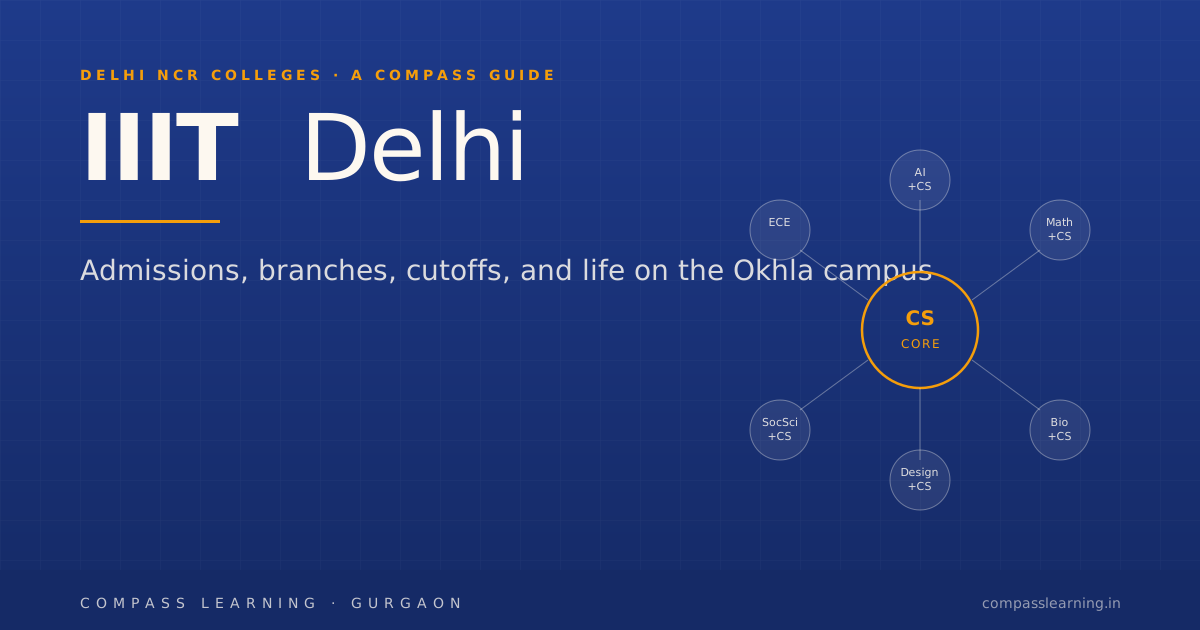
IIIT Delhi has built a deliberately unusual structure where most branches are computer science crossed with another discipline. The current BTech offerings include:
- Computer Science and Engineering (CSE) — the flagship branch
- Computer Science and Artificial Intelligence (CSAI) — added more recently, very high demand
- Computer Science and Applied Mathematics (CSAM) — for students who want depth in mathematics with CS
- Computer Science and Biosciences (CSB) — for students interested in computational biology
- Computer Science and Design (CSD) — design thinking combined with technical foundations
- Computer Science and Social Sciences (CSSS) — quantitative social science, computational economics
- Electronics and Communication Engineering (ECE) — the institute's non-CS branch
- Electronics and VLSI Design and Technology (EVE) — chip design specialisation
The philosophy is intentional: rather than offering a long catalogue of branches with weak placements in some, the institute focuses almost entirely on computing and computing-adjacent fields. If you join IIIT Delhi, you are essentially choosing a CS-first education with optional specialisation in a paired domain.
This is a significant difference from large universities like DTU, where you might find yourself in Civil or Production Engineering with a very different career trajectory.
Cutoffs and competitiveness
Cutoffs depend on three factors: branch, domicile pool (Delhi vs outside-Delhi), and category. In recent years, the rough patterns have been:
- CSE, outside-Delhi general: closes around AIR 4500-6500
- CSAI, outside-Delhi general: closes around AIR 5000-7000
- CSB, CSSS, CSD, outside-Delhi general: typically AIR 8000-13000
- ECE / EVE, outside-Delhi general: typically AIR 11000-15000
- CSE, Delhi domicile general: closes around AIR 8000-11000
- Reserved category cutoffs are correspondingly higher
These ranges shift each year based on how the overall JEE Main result distribution looks and how preferences move during JoSAA rounds. They are useful as orientation, not as targets. For a precise read on your chances, look up the latest JoSAA closing-rank data — IIIT Delhi publishes these too, and so do various third-party rank predictors.
Campus, hostel, and student life
The Okhla campus is compact — about 25 acres — and built up densely. Academic blocks, library, labs, sports facilities, and limited hostel accommodation are all on one connected ground.
A few things to know about life on campus:
- Hostels are limited. First-year students from outside Delhi usually get hostel accommodation. Students from NCR (including Gurgaon) sometimes don't, and may need to commute or take a nearby PG.
- Day scholar culture is significant. Roughly a third of the student body commutes daily. This is unusual for an engineering institute and shapes the social culture — late-night project sessions and dorm life are real but less universal than at, say, DTU or BITS.
- Sports and clubs are active. Despite the small size, the institute has a healthy mix of technical clubs, music groups, debate societies, and sports teams.
- Annual fests: Esya (technical) and Odyssey (cultural) are well-attended events drawing participants from across NCR colleges.
The size of the institute means you will likely know most of your batch personally by the end of the second year. This is a meaningful cultural feature — it cuts both ways. The peer network is tight, but the social variety is narrower than at a larger university.
Placements
IIIT Delhi has consistently strong placement statistics, especially for the computer science branches:
- Average package (CSE): typically ₹25-30 LPA in recent years
- Median package (CSE): typically ₹22-25 LPA
- Highest package: ₹70+ LPA in top years, with occasional offers crossing ₹1 crore
- Top recruiters: Google, Amazon, Microsoft, Adobe, Goldman Sachs, Uber, JP Morgan, and major Indian unicorns and product startups
- Internship pipeline: Strong — most CSE students complete a paid internship between third and fourth year, and many convert these to pre-placement offers
ECE and EVE place reasonably well but with noticeably lower averages, reflecting the smaller pull from non-CS recruiters. The CS-X branches (CSAI, CSAM, CSB, CSD, CSSS) place broadly at CSE levels, since they all sit within the computer science umbrella for hiring purposes.
If placements matter to you, IIIT Delhi sits in the top bracket of state universities and many private institutes too.
Fees and financial aid
IIIT Delhi has a fee structure on the higher end for a state institute. As a rough indication of recent years:
- Tuition + academic charges: ~₹4-4.5 lakh per year
- Hostel + mess (if applicable): additional ~₹1-1.5 lakh per year
- Four-year total: typically in the ₹16-22 lakh range
This is significantly higher than DTU or NSUT, and more in the range of a private engineering university. The institute argues that the higher fees fund the smaller class sizes, better faculty ratios, and stronger research infrastructure — but as a family, this is a real budget consideration.
Scholarships are available:
- Merit-based scholarships for top scorers
- Need-based aid including full tuition waivers for economically backward students
- Various external scholarships that IIIT Delhi students typically qualify for
If finances are a constraint, look up the institute's scholarship schemes early and apply during the admissions cycle. Don't wait until later semesters.
Something to know: IIIT Delhi has had occasional student protests over fee hikes — most notably in years when the institute revised structures sharply upward. The fee structure has historically trended upward year-on-year. Plan for the possibility that the number you see at admission may grow modestly over four years.
For Gurgaon students specifically
If you live in Gurgaon and IIIT Delhi is on your preference list, here are the practical realities:
Commute:
- By Metro: Gurgaon (Huda City Centre / MG Road / Sikanderpur) → Yellow Line to Hauz Khas → Violet Line to Okhla → ~75-90 minutes each way, plus walking on either end
- By car or cab: ~60-75 minutes via NH-48 and Outer Ring Road, depending on traffic
- Reality check: A daily Gurgaon-to-Okhla commute is doable but heavy. Most students who commute end up considering a PG in nearby areas (Kalkaji, Govindpuri) by the second year, even if they started as day scholars.
Hostel vs. commute decision: If you can get hostel allocation, take it — the time saved is substantial and you'll be better integrated socially. If not, plan for either a near-campus PG or a long commute, and budget the hours accordingly.
Alumni in Gurgaon: This is a real advantage. IIIT Delhi alumni are strongly represented in Gurgaon's tech industry — at Microsoft (Sec 18), Adobe, Google's Gurgaon offices, and the major unicorns clustered around Cybercity and Sohna Road. If you ever want a coffee chat with someone three or four years ahead of you, the network is easy to tap. Internships and references through the alumni network are common.
Is IIIT Delhi the right fit?
The institute is a strong fit if:
- You are confident that you want computer science (or a CS variant) and you are willing to commit to that direction
- You value academic rigor and research culture over a more traditional university experience
- You can manage the higher fee structure, or you qualify for substantial scholarship aid
- You are comfortable in a small, dense, urban campus rather than a sprawling one
The fit is less clear if:
- You are unsure between core engineering branches (mechanical, civil, electrical, chemical) — IIIT Delhi simply doesn't offer most of these
- You want the experience of a large, traditional college campus with extensive sports infrastructure
- The fee structure stretches your family's budget without clear paths to aid
- You strongly prefer a hostel-driven, immersive residential culture — the day-scholar share at IIIT Delhi changes that experience
For students choosing between IIIT Delhi and an older IIT branch in a non-CS field — say, IIT Roorkee Mechanical or IIT Guwahati Civil — the question becomes whether brand and broad-engineering exposure matter more, or whether a specialised computing education at a younger institute fits your goals better. This is a genuine decision with no single right answer; it depends on what you actually want to do after the degree.
If you're thinking through engineering admissions and want to talk it through, we're at Ardee City, Sector 52, Gurgaon. Drop by anytime — a fifteen-minute conversation is usually enough to start clarifying which direction makes sense for you.
For more on how admissions, counselling, and college choice fit together, see our full Engineering Admissions Roadmap.