Shiv Nadar University: A Profile of the Interdisciplinary Private University at Greater Noida
A different model than the Delhi state universities
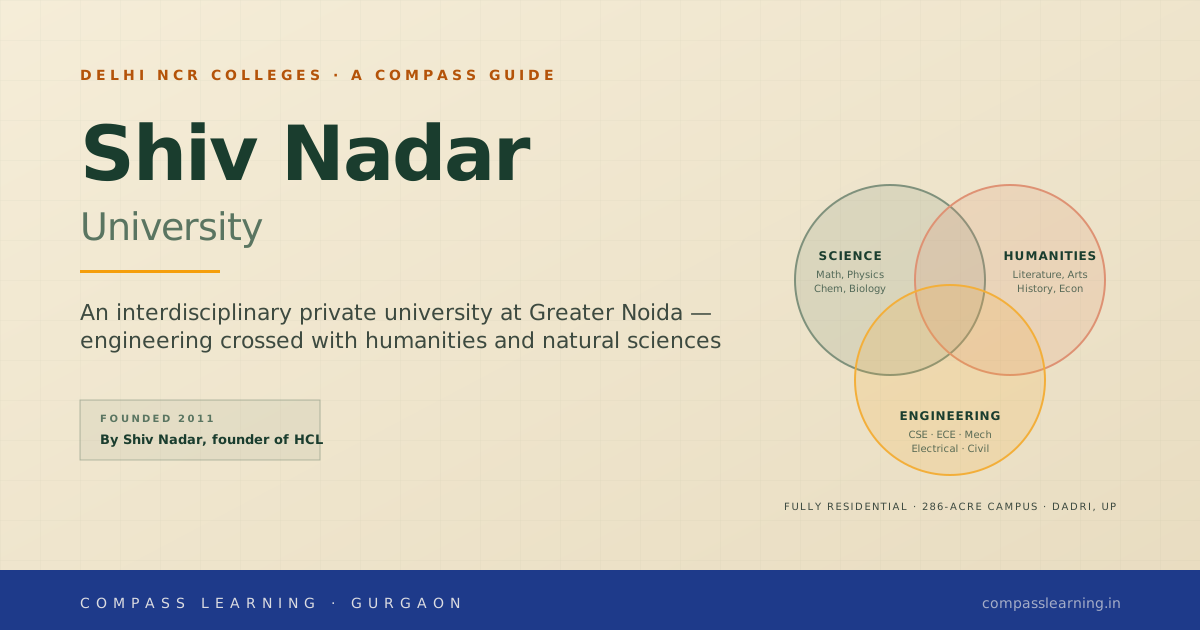
Shiv Nadar University (SNU) was founded in 2011 by Shiv Nadar, the founder of HCL Technologies, with the stated ambition of building a research-led private university with the academic intensity of an IIT and the breadth of a liberal arts college. It operates as a private not-for-profit institution, structurally different from the state universities (DTU, NSUT, IIIT Delhi) and from older private engineering schools (BITS, VIT, Manipal).
The campus sits at Dadri, Uttar Pradesh — about 75-85 km from Gurgaon. SNU is fully residential, deliberately interdisciplinary, and operates on a "Schools" model that mixes engineering with humanities, natural sciences, business, and design. This article walks through what SNU is, how admissions work, what the academic experience is like, and how to think about whether it fits.
Note: This article is written to be evergreen, but specific dates, fees, eligibility thresholds, and cutoff numbers are set each year by the institute. Always cross-check the latest official notifications before acting on anything time-sensitive.
About the university
SNU's distinguishing features compared to other engineering-college options:
- It is research-intensive at the undergraduate level. Faculty members are PhD-holders, often with international research backgrounds, and undergraduates engage in research projects from early semesters.
- It is interdisciplinary by design. A computer science student at SNU is expected to take liberal arts courses, and a humanities student takes science courses. The integration is structural, not optional.
- It is fully residential. Students live on campus throughout the BTech program. Day-scholar attendance is not the norm.
- It is selective. Admissions are competitive — SNU positions itself for top-quartile JEE Main scorers and equivalent.
The campus itself is large (about 286 acres) and architecturally distinctive. The School of Engineering is one of several schools on the same grounds, alongside the School of Natural Sciences, School of Humanities and Social Sciences, School of Management, and the Design School.
How admissions work
SNU's admissions process is different from JoSAA-based admissions at the state universities:
- Entrance exams accepted: JEE Main scores, SAT scores, or SNU's own admission test (SNUSAT). SNU does its own admissions process — you apply directly to the university.
- Class XII boards: PCM aggregate (typically 75%+ for general) is also factored in
- Counselling: SNU runs its own admission rounds, not JoSAA. You apply on SNU's portal during the admission cycle.
- No domicile reservation: SNU is private, so the 85:15 Delhi-vs-outside structure of DTU and NSUT doesn't apply. Students are admitted on merit regardless of state.
If you are targeting SNU, register on SNU's admissions portal separately from JoSAA. Students who only engage with JoSAA cannot end up at SNU — the two admission tracks are independent.
Branches and programs
The School of Engineering offers BTech in:
- Computer Science and Engineering (CSE)
- Computer Science and Engineering with specialisation in Artificial Intelligence (CSE-AI)
- Computer Science and Engineering with specialisation in Cybersecurity (CSE-CS)
- Computer Science and Engineering with specialisation in Data Science (CSE-DS)
- Electronics and Communication Engineering (ECE)
- Electronics and Computer Engineering — a programme bridging electronics and computing
- Electrical Engineering (EE)
- Mechanical Engineering
- Civil Engineering
- Chemical Engineering
Beyond engineering, SNU offers BSc programs in Mathematics, Physics, Chemistry, Biology, Economics, and more — and engineering students can take meaningful coursework across these. This cross-school exposure is one of SNU's main academic selling points.
Cutoffs and competitiveness
Because SNU doesn't use JoSAA, traditional "closing rank" data isn't published the same way. Rough indicators of competitiveness from recent years:
- CSE / CSE-AI / CSE-DS: typically requires JEE Main ~95+ percentile or equivalent strong SNUSAT/SAT performance
- ECE / Electrical: typically JEE Main ~88-92+ percentile
- Mechanical / Civil / Chemical: typically JEE Main ~80-88+ percentile
Performance in Class XII boards and in SNUSAT also matters. A weaker JEE Main rank can be partly compensated by a strong board score or a strong SNUSAT — this is one of the advantages of SNU's multi-criteria admission for students who don't perform best in pure-MCQ exams.
Campus, hostel, and student life
The Dadri campus is large, modern, and built up to international standards. Hostels for boys and girls are spread across the campus, with mess and recreational facilities included.
- Hostels: Available for all students; living on campus is the default expectation
- Academic facilities: Modern lecture halls, labs, library, research centres
- Sports: Substantial outdoor sports infrastructure including cricket, football, athletics, swimming, tennis, basketball, badminton
- Clubs and societies: Wide range across technical, cultural, sports, entrepreneurship, social impact
- Annual fests: Breeze (cultural) and Innodynamix (technical) are major events drawing participants from across NCR colleges
The residential model gives SNU a strong sense of campus community. Students from across India end up living together for four years, which builds a different kind of alumni network than commuter campuses.
Placements
SNU's placement statistics are strong for CSE and reasonable for other branches:
- Average package (CSE): typically ₹22-28 LPA in recent years
- Median package (CSE): typically ₹18-22 LPA
- Highest package: ₹60+ LPA in top years
- Top recruiters: Microsoft, Google, Amazon, Adobe, Goldman Sachs, JP Morgan, McKinsey, several major banks and product companies
- ECE and Electrical: typically ₹12-16 LPA average
- Mechanical / Civil / Chemical: typically ₹6-10 LPA average
The placement distribution at SNU shows a similar pattern to DTU and NSUT — strong CSE outcomes, decent ECE, more moderate core branches. The CSE numbers are comparable to top state universities; the non-CSE numbers are typically lower than what you'd see at DTU/NSUT for the same branches, partly because SNU's brand pull in non-tech industries is still building.
Fees and financial aid
SNU has a private-university fee structure, significantly higher than the state universities:
- Tuition + academic charges: ~₹4.5-5 lakh per year
- Hostel + mess: ~₹1.5-2 lakh per year
- Four-year total: typically ₹24-28 lakh including hostel
This is a substantial cost — comparable to BITS Pilani or other premium private universities, and many times the DTU/NSUT total. For most families, this is the central trade-off when considering SNU.
Scholarships matter a lot at SNU. The university runs several scholarship programs:
- Shiv Nadar Scholar: Full tuition + hostel + stipend, awarded to a small number of top admits each year based on academic and overall profile
- Various merit-based partial scholarships for high JEE Main / SAT / SNUSAT scorers
- Need-based aid for economically disadvantaged students
If your JEE Main score is strong (say, in the top few thousand AIRs), you have a real chance at substantial scholarship — sometimes covering 50-100% of fees. Applying for scholarship during admissions is essential; don't accept SNU at full fees without exploring this carefully.
For Gurgaon students specifically
SNU's location at Dadri (UP) is a significant distance from Gurgaon:
Commute:
- By road: ~75-90 minutes one way via Yamuna Expressway or DND Flyway → Noida → Greater Noida → Dadri, depending heavily on traffic
- By Metro: Possible to reach Greater Noida via Aqua Line from Sector 51 Noida (after Yellow Line transfer), but final leg to campus requires road transit. Total ~120+ minutes.
- Reality check: Daily commute from Gurgaon is not realistic. SNU is residential by design.
Residential expectation: Plan for hostel from day one. SNU is structured around full residential life — academic schedules, evening activities, late-night work, weekend events all assume you live on campus.
Alumni in Gurgaon: SNU's alumni footprint in Gurgaon is growing but still less established than DTU/NSUT (which have decades of graduates). For students graduating now, the alumni network is real and helpful, particularly at HCL and in the broader Gurgaon tech ecosystem; for senior-role conversations, the network is less dense.
What to know before committing
A few items worth weighing honestly:
- The fee structure is real. Even with reasonable scholarship aid, SNU costs significantly more than DTU or NSUT. For families where this is a stretch, look hard at the scholarship application process before committing.
- Non-CSE branch outcomes are moderate. If you're admitted to Mechanical or Chemical at SNU and DTU or NSUT in the same branch is an option, the placement and brand recognition at DTU/NSUT are typically stronger for those branches at this point.
- The institute is relatively young. Founded 2011, so its longest-tenured BTech alumni are roughly a decade into their careers. The senior-leadership alumni network is still building, which matters for things like senior mentor connections and very-senior hiring referrals.
- The interdisciplinary model is a real commitment. You will take humanities and natural sciences courses as part of your engineering degree. This is excellent for students who value broad education, but if you want pure engineering immersion, the structure can feel like a distraction.
Is SNU the right fit?
The university is a strong fit if:
- You value interdisciplinary education and the chance to take courses across humanities and sciences alongside engineering
- You want a fully residential, immersive university experience on a beautiful campus
- You are targeting Computer Science or a CSE specialisation and can compete at the SNU admission bar
- Either the fee structure works for your family, or you qualify for substantial scholarship
- You value the small-cohort, research-intensive academic style over the larger-cohort state university model
The fit is less clear if:
- The fee structure is a significant stretch and your scholarship prospects are uncertain
- You are admitted to a non-CSE branch at SNU but have stronger options at DTU/NSUT in the same branch
- You strongly prefer the immediate alumni-network depth that older institutes offer
- You want a more traditional engineering campus rather than an interdisciplinary university feel
For families weighing SNU CSE against, say, DTU Software Engineering — both are real options. SNU offers a more research-led, interdisciplinary experience at higher cost; DTU offers a more conventional engineering education with stronger immediate brand pull and lower fees. The answer depends on what kind of education you want, not on which institute is "better" in some abstract sense.
If you're thinking through engineering admissions and want to talk it through, we're at Ardee City, Sector 52, Gurgaon. Drop by anytime — a fifteen-minute conversation is usually enough to start clarifying which direction makes sense for you.
For more on how admissions, counselling, and college choice fit together, see our full Engineering Admissions Roadmap.