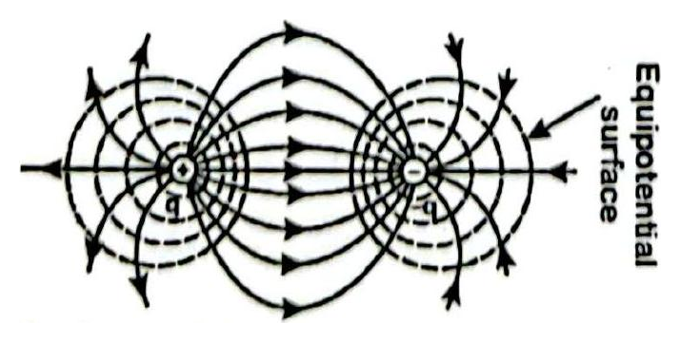
(a) Draw the equipotential surfaces due to an electric dipole. (b) Derive an expression for the electric field due to a dipole of dipole moment p at a point on its perpendicular bisector.
Solution
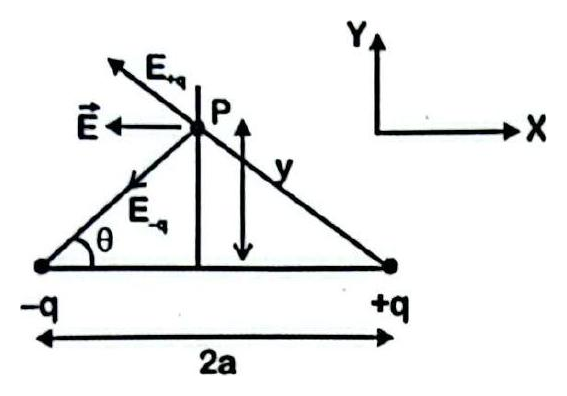
(a) The equipotentials are symmetric about the axis; the equatorial plane is at zero potential. (b) Let P be on the perpendicular bisector at distance r from the centre O. Each charge is at distance r2+a2 from P, so each gives
E+=E−=4πε01r2+a2q
Resolve each field along and perpendicular to the axis. The perpendicular components cancel; the axial components E+cosθ add, with cosθ=r2+a2a: