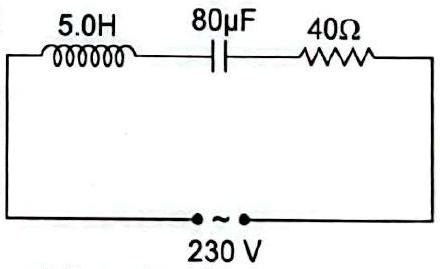
The given circuit diagram shows a series LCR circuit with L=5.0H, C=80μF and R=40Ω connected to a variable-frequency 230 V source. (a) Determine the source frequency which drives the circuit in resonance. (b) Obtain the impedance of the circuit and the amplitude of the current at the resonating frequency. (c) Determine the rms potential drops across the three elements of the circuit. (d) How do you explain the observation that the algebraic sum of the voltages across the three elements obtained in (c) is greater than the supplied voltage?
(b) At resonance XL=XC, so the impedance is minimum:
Z=R=40Ω
I0=RV0=R2Vrms=402×230≈8.13A
(c) Irms=RVrms=40230=5.75 A.
VR=IrmsR=5.75×40=230V
VL=IrmsωrL=5.75×50×5=1437.5V
VC=ωrCIrms=50×80×10−65.75=1437.5V
(d) The three voltages are not in phase. VL leads and VC lags the current by 2π, so they are in antiphase and, being equal at resonance, cancel exactly. The source voltage equals the phasor sum VR2+(VL−VC)2=VR=230 V, not the algebraic sum.