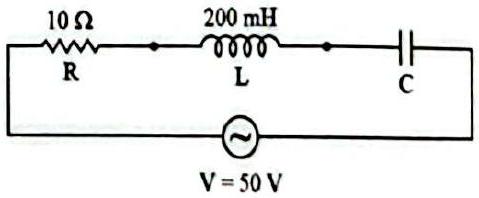
In the circuit shown, a resistor R=10Ω and an inductor L=200mH are connected in series with a capacitor C and an a.c. source of rms voltage 50 V and angular frequency 100s−1. Calculate (a) the capacitance of the capacitor if the power factor of the circuit is unity, (b) the Q-factor of this circuit and state the significance of the Q-factor in an a.c. circuit, and (c) the average power dissipated in the circuit.
Answer: (a) C=0.5mF=500μF; (b) Q=2 (it measures the sharpness of resonance); (c) P=250 W.
Solution
(a) Unity power factor means the circuit is at resonance, XL=XC, so ω=LC1:
C=ω2L1=(100)2×0.21=20001=5×10⁻⁴F=0.5mF
(b)
Q=R1CL=1015×10−40.2=101400=101×20=2
The Q-factor measures the sharpness (selectivity) of resonance — a higher Q gives a narrower, sharper resonance peak. (c) At resonance Z=R, so Irms=RVrms=1050=5 A and cosϕ=1: