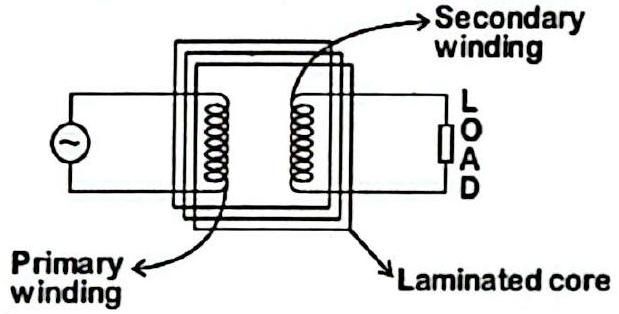
(a) Draw the diagram of a device which is used to decrease a high a.c. voltage into a low a.c. voltage and state its working principle. Write four sources of energy loss in this device. (b) A small town with a demand of 1200 kW of electric power at 220 V is situated 20 km away from an electric plant generating power at 440 V. The resistance of the two-wire line carrying power is 0.5Ω per km. The town gets the power from the line through a 4000–220 V step-down transformer at a sub-station in the town. Estimate the line power loss in the form of heat.
Solution
(a) The device is a step-down transformer (Ns<Np), working on mutual induction: a changing flux produced by the primary induces a (smaller) emf in the secondary. Four sources of energy loss are copper (I2R) loss in the windings, eddy-current loss in the core, hysteresis loss in the core, and flux-leakage loss. (b) Total line resistance (two wires, 20 km each way):
R=(20+20)×0.5=20Ω
The line is fed at the sub-station input voltage 4000 V, so the line current is