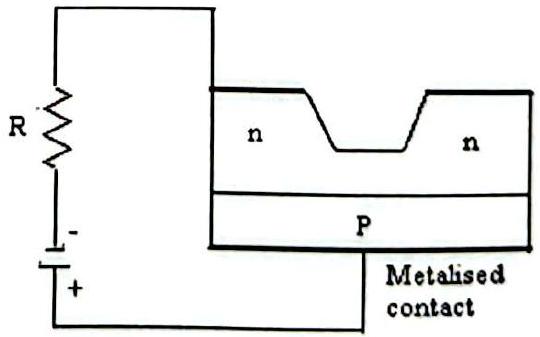
Explain, with the help of a schematic diagram, the principle and working of a Light Emitting Diode. What criterion is kept in mind while choosing the semiconductor material for such a device? Write any two advantages of a Light Emitting Diode over conventional incandescent lamps.
Solution
Principle: in a forward-biased junction, electrons and holes are driven to the junction where they recombine; the energy released (equal to the band gap) is emitted as a photon. Working: the LED is forward biased; near-junction recombination produces light whose colour depends on the band gap Eg (since hν≈Eg). Material criterion: the semiconductor's band gap must correspond to the desired wavelength (typically 1.8–3eV for visible light), which is why compound semiconductors like GaAsP are used rather than Si or Ge. Advantages: (i) low operating voltage and power; (ii) nearly monochromatic light, fast switching and long life. hν≈Eg;choose Eg for required colour.