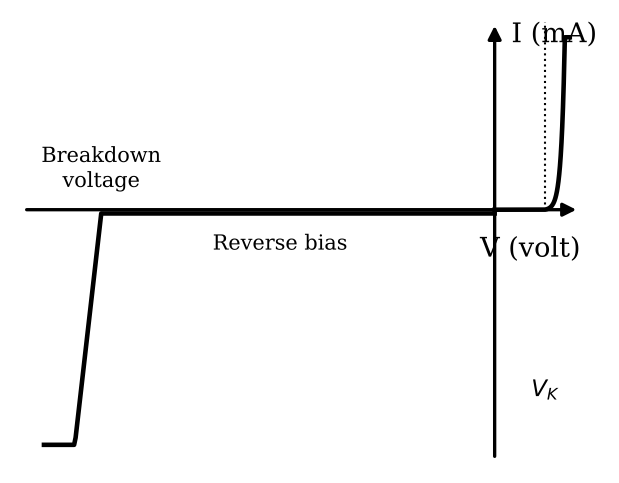
Draw the V-I characteristics of a p-n junction diode. Answer the following, giving reasons: (i) Why is the current under reverse bias almost independent of the applied potential up to a critical voltage? (ii) Why does the reverse current show a sudden increase at the critical voltage? Name any semiconductor device which operates under reverse bias in the breakdown region.
Solution
(i) In reverse bias the current is carried by the few thermally generated minority carriers; even a small voltage sweeps essentially all of them across, so the current saturates and stays almost constant with increasing reverse voltage. (ii) At the critical (breakdown) voltage the strong field breaks many covalent bonds (avalanche/zener breakdown), generating a large number of electron-hole pairs, so the reverse current increases abruptly. A semiconductor device operated in this breakdown region is the zener diode. Saturation current; breakdown at critical voltage; zener diode.