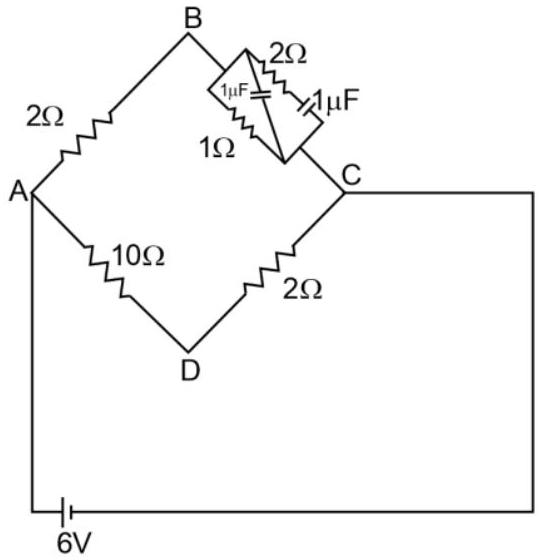
For the given circuit, in the steady state, ∣VB−VD∣= ____ V.
Answer: 1
Solution
In the steady state no charge flows into the capacitors, so the two 1μF branches and the 2Ω arm placed in series with a capacitor between B and C carry no current; the only conducting link between B and C is the 1Ω resistor. The upper path from A is then the 2Ω arm AB in series with the 1Ω arm BC, a resistance of 3Ω, while the lower path A−10Ω−D−2Ω−C has resistance 12Ω, and both are driven by the full 6 V of the cell across A and C. The upper branch carries 36=2 A, so the drop across AB is 2×2=4 V and B lies 4 V below A. The lower branch carries 126=0.5 A, so the drop across AD is 0.5×10=5 V and D lies 5 V below A. The magnitude of the difference between B and D is therefore ∣(−4)−(−5)∣=1 V.
JEE Main · 2023 · 31 Jan 2023 · Shift 2 · Integer answer