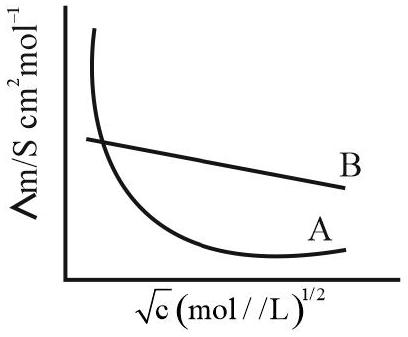
Following figure shows dependence of molar conductance of two electrolytes on concentration. Λm0 is the limiting molar conductivity.
The number of Incorrect statement(s) from the following is ______ (A) Λm0 for electrolyte A is obtained by extrapolation (B) For electrolyte B, Λm vs c graph is a straight line with intercept equal to Λm0 (C) At infinite dilution, the value of degree of dissociation approach zero for electrolyte B. (D) Λm0 for any electrolyte A or B can be calculated using λ∘ for individual ions.
Answer: 2
Solution
Curve A climbs steeply as the concentration falls towards zero, the mark of a weak electrolyte whose limiting molar conductivity cannot be read off by straight extrapolation; line B is nearly straight, the behaviour of a strong electrolyte. The claim that Λm0 of A is obtained by extrapolation is therefore wrong, and the claim that the degree of dissociation tends to zero at infinite dilution is wrong because there it tends to unity. The statement that B gives a straight Λm against c line of intercept Λm0, and that Λm0 of either electrolyte can be built from the individual ionic conductivities by Kohlrausch's law, are both sound. The number of incorrect statements is two.
JEE Main · 2023 · 29 Jan 2023 · Shift 1 · Integer answer