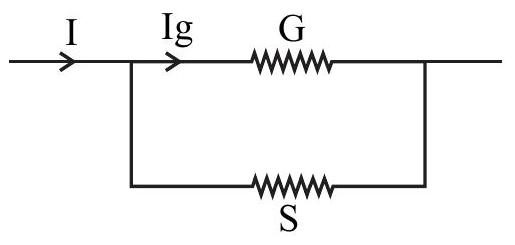
A teacher in his physics laboratory allotted an experiment to determine the resistance (G) of a galvanometer. Students took the observations for 31 deflection in the galvanometer. Which of the below is true for measuring value of G?
(A)31 deflection method cannot be used for determining the resistance of the galvanometer.
(B)31 deflection method can be used and in this case the G equals to twice the value of shunt resistance(s).✓ Correct
(C)31 deflection method can be used and in this case, the G equals to three times the value of shunt resistance(s)
(D)31 deflection method can be used and in this case the G value equals to the shunt resistance(s).
Answer: (B)
Solution
In the shunt method, the current divides between the galvanometer (resistance G) and the shunt (resistance S). The current ratio is:
IIg=S+GS
For 31 deflection, Ig=3I:
31=S+GS
Solving: S+G=3S, which gives G=2S.
Thus, the galvanometer resistance equals twice the shunt resistance.
JEE Main · 2022 · 25 Jun 2022 · Shift 1 · Single correct option