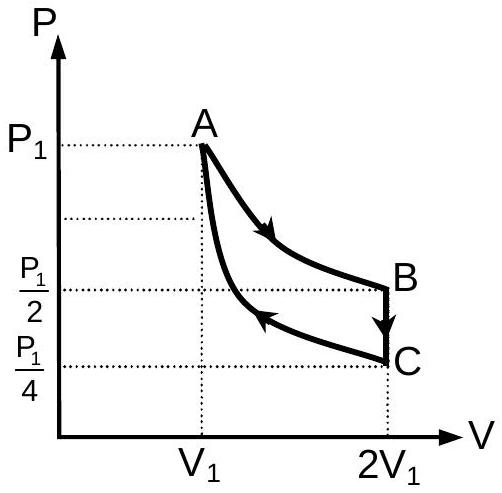
If one mole of an ideal gas at ( P1V1 ) is allowed to expand reversibly and isothermally ( A to B ) its pressure is reduced to one- half of the original pressure (see figure). This is followed by a constant volume cooling till its pressure is reduced to one-fourth of the initial value (B→C). Then it is restored to its initial state by a reversible adiabatic compression ( C to A ). The net work done by the gas is equal to:
(A)0
(B)RTln2
(C)RT(ln2−2(γ−1)1)✓ Correct
(D)−2(γ−1)RT
Answer: (C)
Solution
Along the isothermal A→B the pressure halves, so the volume doubles to 2V1 and
WAB=RTlnV12V1=RTln2
The cooling B→C is at constant volume, so WBC=0. At C the state is (4P1,2V1), which gives
TC=R(P1/4)(2V1)=2RP1V1=2T
For the adiabatic compression C→A the work done by the gas is
WCA=γ−1R(TC−TA)=γ−1R(2T−T)=−2(γ−1)RT
Adding the three contributions, the net work done by the gas over the cycle is RT(ln2−2(γ−1)1).
JEE Main · 2021 · 24 Feb 2021 · Shift 2 · Single correct option