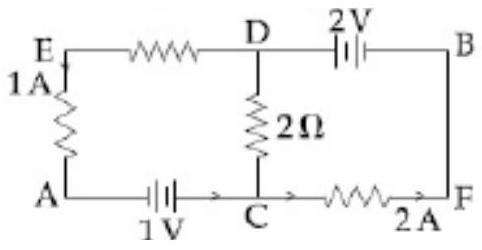
In the circuit, given in the figure currents in different branches and value of one resistor are shown. Then potential at point B with respect to the point A is:
(A)+1 V✓ Correct
(B)-1 V
(C)+2 V
(D)-2 V
Answer: (A)
Solution
Take the potential at A as the reference, VA=0. The junction rule at C requires the incoming currents to balance the outgoing one, so 1+i3=2, giving i3=1 A. Now trace the potential from A to B along the branch through C and D, adding the rise across the source and the drop across the 2Ω resistor: VA+1+i3(2)−2=VB. Substituting, 0+1+(1)(2)−2=VB, so VB=+1 V. The potential at B with respect to A is therefore +1 V.
JEE Main · 2020 · 05 Sep 2020 · Shift 2 · Single correct option