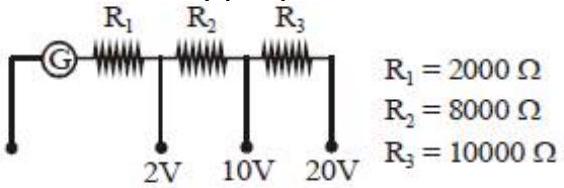
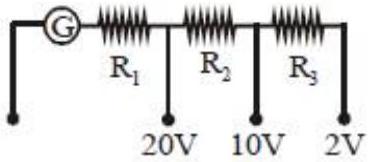
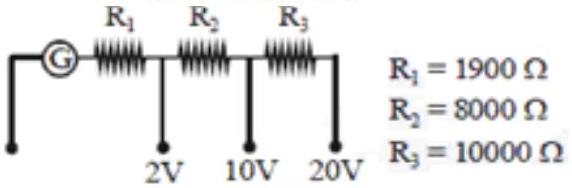
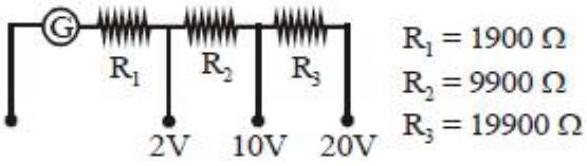
A galvanometer of resistance 100Ω has 50 divisions on its scale and has sensitivity of 20μA/ division. It is to be converted to a voltmeter with three ranges, of 0−2V,0−10V and 0−20V. The appropriate circuit to do so is :
(A)(see structure)✓ Correct
(B)(see structure)
(C)(see structure)
(D)(see structure)
Answer: (A)
Solution
The full-scale galvanometer current is Ig=50×20×10−6=1mA. A voltmeter is made by placing a multiplier resistance in series, chosen from V=Ig(Rg+Rseries). For the 0–2V range, 2=10−3(100+R1) gives R1=1900Ω. Tapping further along for 0–10V, 10=10−3(2000+R2) gives an added R2=8000Ω. For 0–20V, 20=10−3(10000+R3) gives a further R3=10000Ω. The correct arrangement is these three multipliers in series with the galvanometer, with the three ranges taken off successive taps at 1900Ω, 8000Ω and 10000Ω.
JEE Main · 2019 · 12 Apr 2019 · Shift 1 · Single correct option