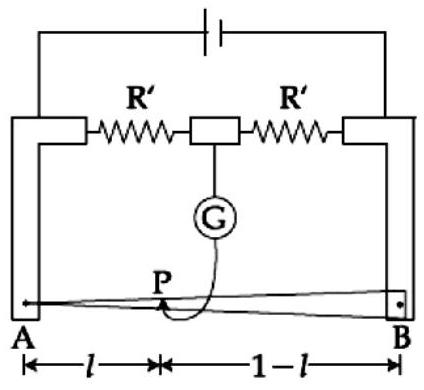
In a meter bridge, the wire of length 1 m has a nonuniform cross-section such that, the variation dℓdR of its resistance R with length ℓ is dℓdR∝ℓ1. Two equal resistances are connected as shown in the figure. The galvanometer has zero deflection when the jockey is at point P. What is the length AP?
(A)0.2 m
(B)0.3 m
(C)0.25 m✓ Correct
(D)0.35 m
Answer: (C)
Solution
Because the cross-section is non-uniform, resistance is not proportional to length; instead dℓdR∝ℓ1, so dℓdR=ℓc for some constant c. Integrating from one end, the resistance up to length ℓ is R(ℓ)=2cℓ, and the whole metre of wire has resistance R(1)=2c. The two external resistances are equal, so balance of the bridge requires the segment AP to carry half the total wire resistance, RAP=c. Setting 2cℓ=c gives ℓ=21, so the balancing length is ℓ=41=0.25m.
JEE Main · 2019 · 12 Jan 2019 · Shift 1 · Single correct option