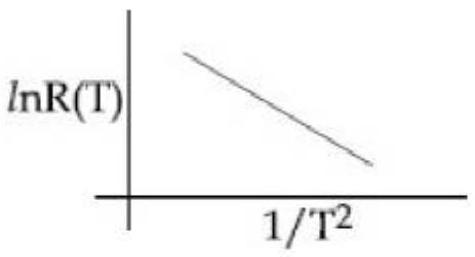
In an experiment, the resistance of a material is plotted as a function of temperature (in some range). As shown in the figure, it is a straight line. One may conclude that:
(A)R(T)=R0eT2/T02
(B)R(T)=T2R0
(C)R(T)=R0e−T2/T02
(D)R(T)=R0e−T02/T2✓ Correct
Answer: (D)
Solution
In the figure the vertical axis is lnR(T) and the horizontal axis is 1/T2, and the points fall on a straight line that slopes downward. So lnR(T) is a linear function of 1/T2: lnR(T)=lnR0+m(T21), where the intercept at 1/T2=0 is lnR0 and m is the slope. Because the line falls, the slope is negative; writing it as m=−T02 gives lnR(T)=lnR0−T2T02. Taking the exponential of both sides, R(T)=R0e−T02/T2. This behaves sensibly: as T grows the exponent −T02/T2 climbs toward 0 and R rises toward R0, while as T falls the resistance drops steeply, exactly as a straight line in 1/T2 demands.
JEE Main · 2019 · 10 Apr 2019 · Shift 1 · Single correct option