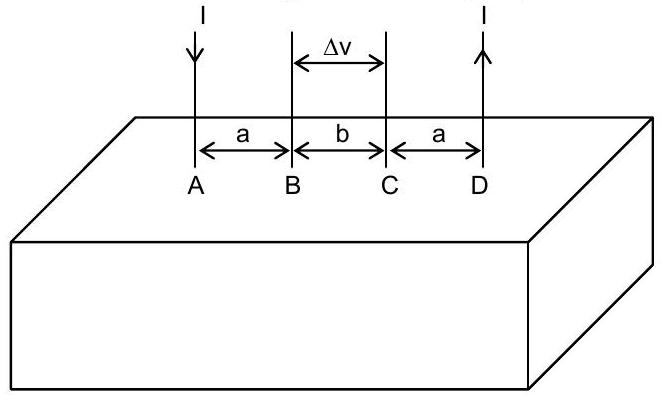
Consider a block of conducting material of resistivity ' ρ ' shown in the figure. Current ' I ' enters at 'A' and leaves from ' D '. We apply superposition principle to find voltage ' ΔV ' developed between ' B ' and ' C '. The calculation is done in the following steps: (i) Take current ' l ' entering from ' A ' and assume it to spread over a hemispherical surface in the block. (ii) Calculate field E(r) at distance ' r ' from A by using Ohm's law E=ρj, where j is the current per unit area at ' r '. (iii) From the ' r ' dependence of E(r), obtain the potential V(r) at r. (iv) Repeat (i), (ii) and (iii) for current ' I ' leaving ' D ' and superpose results for ' A ' and ' D '.
ΔV measured between B and C is
(A)πaρl−π(a+b)ρl
(B)aρl−(a+b)ρl
(C)2πaρl−2π(a+b)ρl✓ Correct
(D)2π(a−b)ρl
Answer: (C)
Solution
Following the prescribed scheme, the current entering at A spreads over a hemisphere, so at radius r the field is E=ρj=2πr2ρI and the potential it sets up is V(r)=2πrρI. Point B lies at distance a from A and point C at distance a+b, so the potential difference developed between them is VB−VC=2πρI(a1−a+b1), which is the voltage measured between B and C.
JEE Main · 2008 · 27 Apr 2008 · Offline · Single correct option