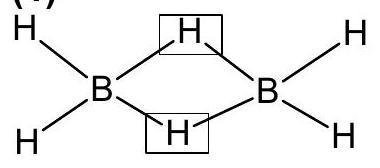
Diborane, BX2HX6, famously cannot be drawn with ordinary two-electron bonds everywhere. Its four terminal B−H bonds are normal two-centre two-electron bonds, but the two bridging hydrogens each sit in a B−H−B three-centre two-electron bond, where a single pair of electrons is shared across three atoms. So the structure holds four 2c-2e bonds and two 3c-2e bonds.
JEE Main · 2005 · 08 May 2005 · Offline · Single correct option