Consider the function f:(−2π,2π)→(−∞,∞) defined by
f(x)=(∣x∣+∣x−1∣)sinx+[xsinx],
where [x sin x] is the greatest integer less than or equal to x sinx. Let α be the total number of points in the interval (−2π,2π) at which f is NOT continuous, and let β be the total number of points in the interval (−2π,2π) at which f is NOT differentiable. Then the value of α+β is ____.
Answer: 5
Solution
Let g(x)=xsinx. Then g′(x)=sinx+xcosx.
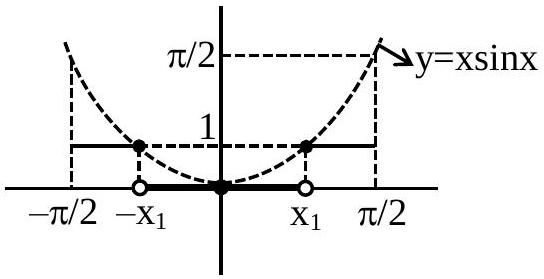
For x∈[0,π/2): g′(x)≥0, so g is increasing. For x∈(−π/2,0]: g′(x)≤0, so g is decreasing.
The function [xsinx] has jump discontinuities at points x1,−x1 where x1sinx1 is an integer in (0,π/2). There are exactly 2 such points.
The function (∣x∣+∣x−1∣)sinx is continuous everywhere but not differentiable at x=0 and x=1. However, at x=0, both terms are differentiable, so f is differentiable there. At x=1, the first term is not differentiable but the second is, so f is not differentiable.
At x1,−x1: [xsinx] is discontinuous, so f is discontinuous. Also not differentiable.
So α=2 (discontinuities at x1,−x1) β=3 (non-differentiable at x1,−x1,1)
α+β=5.
JEE Advanced · 2026 · 17 May 2026 · Paper 1 · Numerical answer