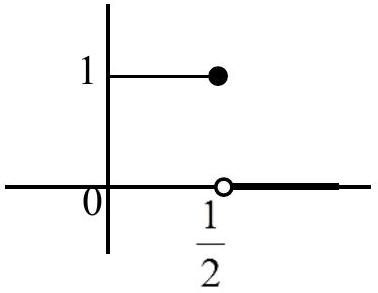
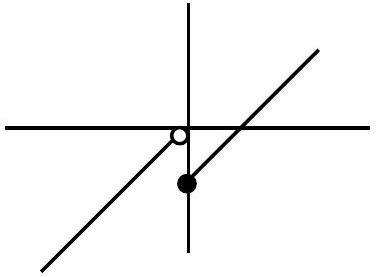
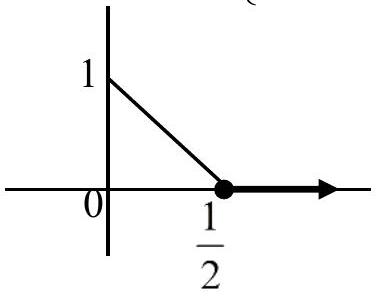
f(x)={x∣x∣sin(x1),0,x=0,x=0, and g(x)={1−2x,0,0≤x≤21, otherwise .
Let a,b,c,d∈R. Define the function h:R→R by
h(x)=af(x)+b(g(x)+g(21−x))+c(x−g(x))+dg(x),x∈R
Match each entry in List-I to the correct entry in List-II.
List-I
List-II
(P)
If a=0,b=1,c=0 and d=0, then
(1)
h is one-one.
(Q)
If a=1,b=0,c=0 and d=0, then
(2)
h is onto.
(R)
If a=0,b=0,c=1 and d=0, then
(3)
h is differentiable on R.
(S)
If a=0,b=0,c=0 and d=1, then
(4)
the range of h is [0,1].
(5)
the range of h is {0,1}.
The correct option is :
(A)(P)→(4)(Q)→(3)(R)→(1)(S)→(4)
(B)(P)→(5)(Q)→(2)(R)→(4)(S)→(3)
(C)(P)→(5)(Q)→(3)(R)→(2)(S)→(4)✓ Correct
(D)(P)→(4)(Q)→(2)(R)→(1)(S)→(3)
Answer: (C)
Solution
First, note that:
g(x)+g(21−x)={10if 0≤x≤21otherwise
(P)a=0,b=1,c=0,d=0: h(x)=g(x)+g(21−x), which equals 1 on [0,21] and 0 elsewhere. Range is {0,1}. So (P)→(5).
(Q)a=1,b=0,c=0,d=0: h(x)=f(x)=x∣x∣sin(x1) for x=0, and h(0)=0. This function is differentiable everywhere (including at 0, where both left and right derivatives are 0). So (Q)→(3).
(R)a=0,b=0,c=1,d=0: h(x)=x−g(x). For 0≤x≤21, h(x)=x−(1−2x)=3x−1, which ranges from -1 to 21. For x<0 or x>21, h(x)=x, which covers (−∞,0)∪(21,∞). Combined, the range is R, so h is onto. So (R)→(2).
(S)a=0,b=0,c=0,d=1: h(x)=g(x)=1−2x for 0≤x≤21, and 0 elsewhere. Range is [0,1]. So (S)→(4).
Correct matching: (P)→(5), (Q)→(3), (R)→(2), (S)→(4), which is option (C).
JEE Advanced · 2024 · 26 May 2024 · Paper 1 · Single correct option