Let R denote the set of all real numbers. Let f:R→R be defined by
f(x)={2x+sinx6x+sinx37 if x=0, if x=0.
Then which of the following statements is (are) TRUE?
(A)The point x=0 is a point of local maxima of f
(B)The point x=0 is a point of local minima of f✓ Correct
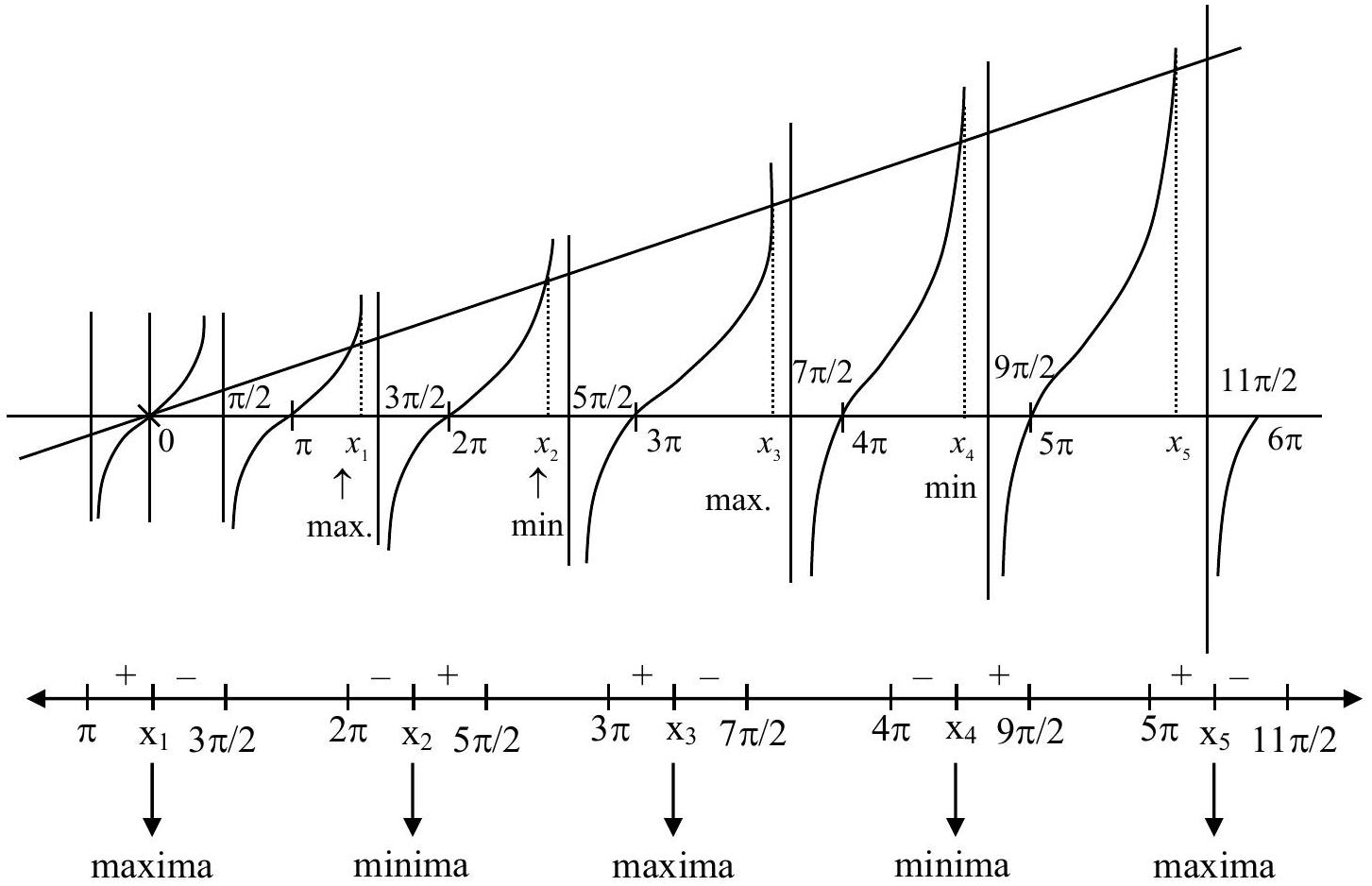
(C)Number of points of local maxima of f in the interval [π,6π] is 3✓ Correct
(D)Number of points of local minima of f in the interval [2π,4π] is 1✓ Correct
Answer: (B), (C), (D)
Solution
Write f(x)=1+2x+sinx4x. Expanding near 0 with sinx≈x−6x3 gives f(x)≈37+272x2, so f has a local minimum at x=0. Away from 0, f′(x)=(2x+sinx)24(sinx−xcosx), which vanishes where tanx=x; these roots occur once in each period, near 4.49,7.73,10.90,14.07,17.28,…. Testing the sign of sinx−xcosx across each root shows the maxima fall at 4.49,10.90,17.28,… and the minima at 7.73,14.07,…. Thus in [π,6π] there are three maxima (4.49,10.90,17.28), and in [2π,4π] there is one minimum (7.73). So the minimum at 0, the count of three maxima, and the count of one minimum all hold.
JEE Advanced · 2025 · 18 May 2025 · Paper 2 · One or more correct options