Let S be the set of all twice differentiable functions f from R to R such that dx2d2f(x)>0 for all x∈(−1,1). For f∈S, let Xf be the number of points x∈(−1,1) for which f(x)=x. Then which of the following statements is(are) true?
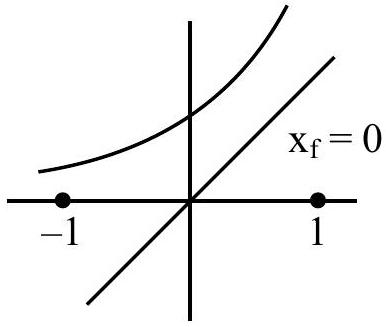
(A)There exists a function f∈S such that Xf=0✓ Correct
(B)For every function f∈S, we have Xf≤2✓ Correct
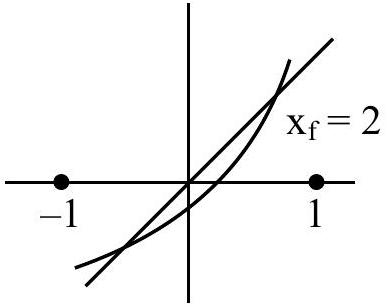
(C)There exists a function f∈S such that Xf=2✓ Correct
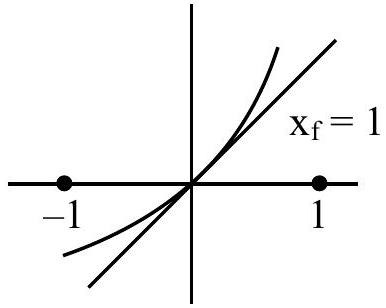
(D)There does NOT exist any function f in S such that Xf=1
Answer: (A), (B), (C)
Solution
Since f′′(x)>0 on (−1,1), the function f is strictly convex on this interval.
Let ϕ(x)=f(x)−x. Then ϕ′′(x)=f′′(x)>0.
Since ϕ′′(x)>0, ϕ′(x) is strictly increasing, so ϕ′(x)=0 has at most one solution in (−1,1).
Therefore ϕ(x)=0 (i.e., f(x)=x) has at most 2 solutions in (−1,1).
This proves (B): Xf≤2 for all f∈S.
(A) is true: take f(x)=x2+2. Then f′′(x)=2>0 and f(x)=x gives x2−x+2=0, which has no real solutions.
(C) is true: take f(x)=x2. Then f(x)=x gives x2=x, so x=0 or x=1. In (−1,1), we have x=0 only... Actually, we need a better example. Consider f(x)=(x−a)2+a and f(x)=(x−b)2+b where we can arrange two intersections.
(D) is false: we can construct functions with exactly one intersection.
JEE Advanced · 2023 · 04 Jun 2023 · Paper 2 · One or more correct options