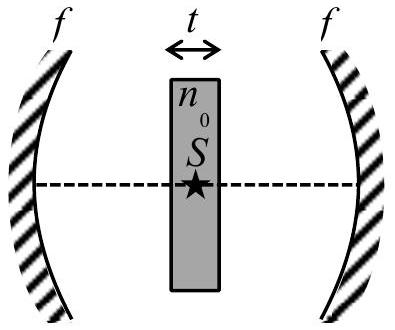
Two identical concave mirrors each of focal length f are facing each other as shown in the schematic diagram. The focal length f is much larger than the size of the mirrors. A glass slab of thickness t and refractive index n0 is kept equidistant from the mirrors and perpendicular to their common principal axis. A monochromatic point light source S is embedded at the center of the slab on the principal axis, as shown in the schematic diagram. For the image to be formed on S itself, which of the following distances between the two mirrors is/are correct:
(A)4f+(1−n01)t✓ Correct
(B)2f+(1−n01)t✓ Correct
(C)4f+(n0−1)t
(D)2f+(n0−1)t
Answer: (A), (B)
Solution
For the image to form at S itself, light from S must retrace its path after reflection from either mirror.
The optical path from S to one mirror is:
2S−t+2n0t
For the image to coincide with the object after one reflection:
2S−t+2n0t=2f⟹S=4f+(1−n01)t
For the image to coincide after reflection from the center of curvature:
2S−t+2n0t=f⟹S=2f+(1−n01)t
Options (A) and (B) are correct.
JEE Advanced · 2025 · 18 May 2025 · Paper 2 · One or more correct options