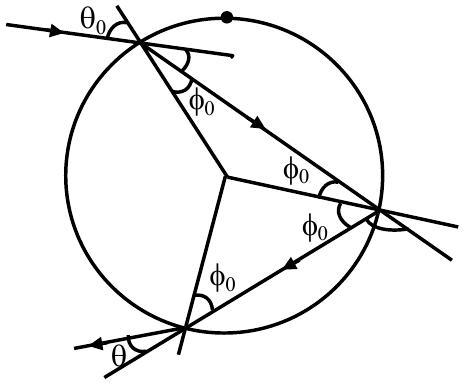
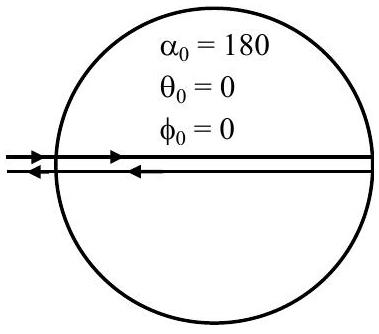
A light ray is incident on the surface of a sphere of refractive index n at an angle of incidence θ0. The ray partially refracts into the sphere with angle of refraction ϕ0 and then partly reflects from the back surface. The reflected ray then emerges out of the sphere after a partial refraction. The total angle of deviation of the emergent ray with respect to the incident ray is α. Match the quantities mentioned in List-I with their values in List-II and choose the correct option.
List-I
(P)
If n=2 and α=180∘, then all the possible values of θ0 will be
(Q)
If n=3 and α=180∘, then all the possible values of θ0 will be
(R)
If n=3 and α=180∘, then all the possible values of ϕ0 will be
(S)
If n=2 and θ0=45∘, then all the possible values of α will be
List-II
(1)
30° and 0°
(2)
60° and 0°
(3)
45° and 0°
(4)
150°
(5)
0°
(A)P→5;Q→2;R→1;S→4✓ Correct
(B)P→5;Q→1;R→2;S→4
(C)P→3;Q→2;R→1;S→4
(D)P→3;Q→1;R→2;S→5
Answer: (A)
Solution
The total deviation is α=180+2θ0−4ϕ0. For α=180∘: θ0=2ϕ0. (P) With n=2: sinθ0=2sin(θ0/2) gives cos(θ0/2)=1, so θ0=0 (P→5). (Q) With n=3: sinθ0=3sin(θ0/2) gives cos(θ0/2)=23, so θ0=60∘ and 0∘ (Q→2). (R) From θ0=2ϕ0 and sin2ϕ0=3sinϕ0: cosϕ0=23, giving ϕ0=30∘ and 0∘ (R→1). (S) With n=2 and θ0=45∘: sin45∘=2sinϕ0 gives ϕ0=30∘, and α=180+90−120=150∘ (S→4).
JEE Advanced · 2024 · 26 May 2024 · Paper 1 · Single correct option