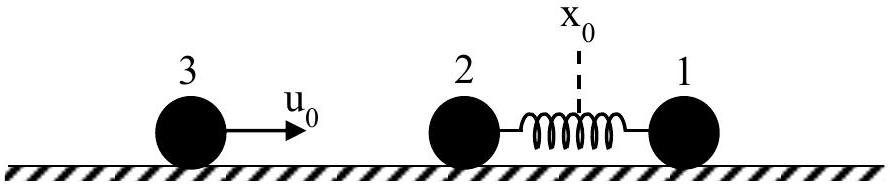
Two particles, 1 and 2, each of mass m, are connected by a massless spring, and are on a horizontal frictionless plane, as shown in the figure. Initially, the two particles, with their center of mass at x0, are oscillating with amplitude a and angular frequency ω. Thus, their positions at time t are given by x1(t)=(x0+d)+asinωt and x2(t)=(x0−d)−asinωt, respectively, where d>2a. Particle 3 of mass m moves towards this system with speed u0=aω/2, and undergoes instantaneous elastic collision with particle 2, at time t0. Finally, particles 1 and 2 acquire a center of mass speed vcm and oscillate with amplitude b and the same angular frequency ω.
If the collision occurs at time t0=π/(2ω), then the value of 4b2/a2 will be ____.
Answer: 4.25
Solution
At t0=π/(2ω)=T/4, both particles are at their extreme positions with zero velocity.
Particle 2 is at rest when particle 3 (moving with speed aω/2) collides with it. After elastic collision between equal masses, they exchange velocities:
Particle 2 acquires velocity aω/2
Particle 3 comes to rest
The center of mass velocity of particles 1 and 2:
vcm=2m0+m(aω/2)=4aω
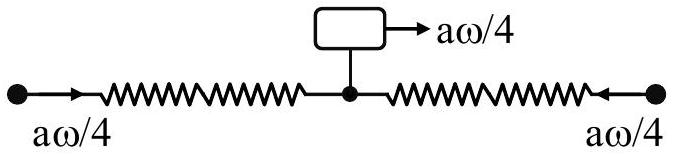
In the CM frame, the initial spring extension is 2a (particles at extremes). After collision, particle 2 has velocity aω/4 relative to CM.
Using energy conservation in the CM frame:
21k(2b)2−21k(2a)2=2×21m(4aω)2
Since ω2=k/(2m) for the two-particle system:
4kb2−4ka2=m×8a2ω2=m×16ma2k=16ka2
4b2=4a2+4a2=417a2
a24b2=4.25
JEE Advanced · 2024 · 26 May 2024 · Paper 2 · Numerical answer