The complex(es), which can exhibit the type of isomerism shown by , is(are)
- (A)
- (B)
- (C)✓ Correct
- (D)✓ Correct
Answer: (C), (D)
Solution
is square planar ( hybridization) and exhibits cis-trans (geometrical) isomerism.
For a complex to show the same type of isomerism:
(A) : Square planar, but en is a bidentate chelating ligand that occupies adjacent positions, so cis-trans isomerism is not possible.
(B) : Tetrahedral geometry—no cis-trans isomerism in tetrahedral complexes.
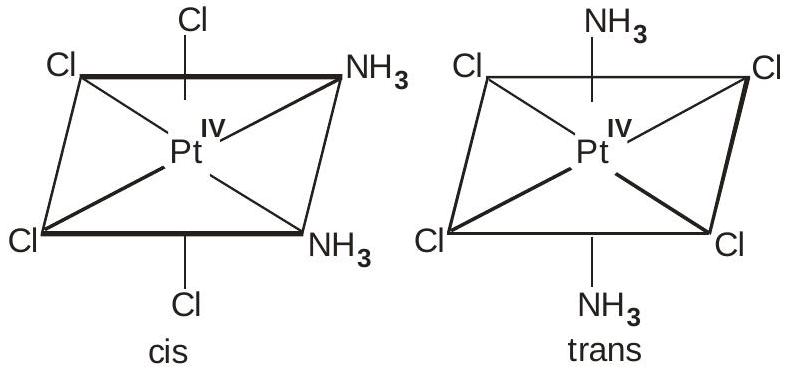
(C) : Octahedral geometry with two ligands—can exhibit cis-trans isomerism.
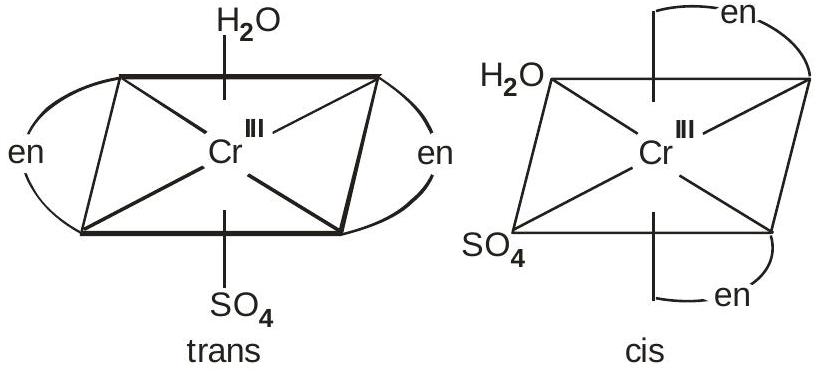
(D) : Octahedral with two bidentate en ligands, one , and one —can exhibit cis-trans isomerism.
Therefore, (C) and (D) are correct.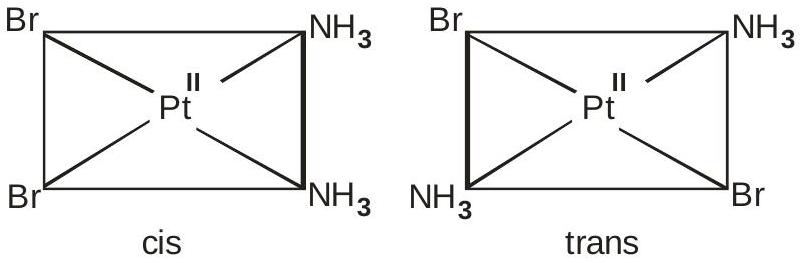
For a complex to show the same type of isomerism:
(A) : Square planar, but en is a bidentate chelating ligand that occupies adjacent positions, so cis-trans isomerism is not possible.
(B) : Tetrahedral geometry—no cis-trans isomerism in tetrahedral complexes.
(C) : Octahedral geometry with two ligands—can exhibit cis-trans isomerism.
(D) : Octahedral with two bidentate en ligands, one , and one —can exhibit cis-trans isomerism.
Therefore, (C) and (D) are correct.
JEE Advanced · 2023 · 04 Jun 2023 · Paper 2 · One or more correct options