Let the functions f:(−1,1)→R and g:(−1,1)→(−1,1) be defined by
f(x)=∣2x−1∣+∣2x+1∣ and g(x)=x−[x],
where [x] denotes the greatest integer less than or equal to x. Let f∘g:(−1,1)→R be the composite function defined by (f∘g)(x)=f(g(x)). Suppose c is the number of points in the interval (−1,1) at which f∘g is NOT continuous, and suppose d is the number of points in the interval (−1,1) at which f∘g is NOT differentiable. Then the value of c+d is ____
Answer: 4
Solution
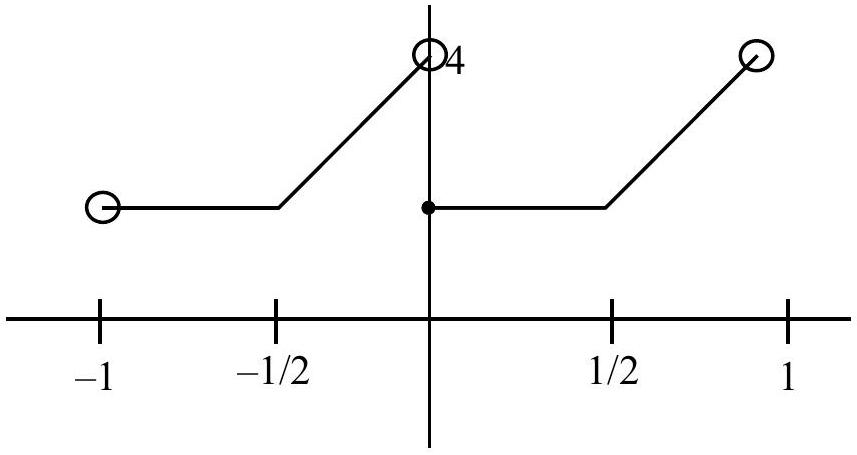
We have g(x)={x} (fractional part). Then f(g(x))=∣2{x}−1∣+∣2{x}+1∣. For x∈(−1,1), {x}=x when x≥0 and {x}=x+1 when x<0. Analyzing the composite function:
f(g(x))={24{x}{x}≤1/2{x}>1/2
The function is discontinuous at x=0 (where g jumps), so c=1. It is non-differentiable at x=−1/2,0,1/2 (corners in the absolute value function), so d=3. Therefore, c+d=4.