JEE Advanced · 2019 · 27 May 2019 · Paper 1 · Surface Chemistry

WhatsApp Email
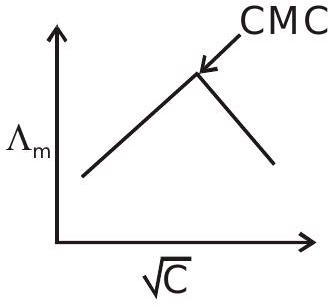
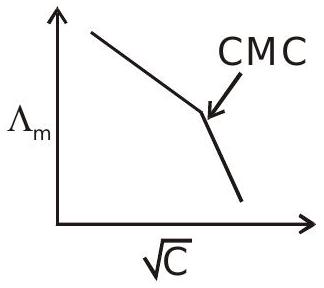
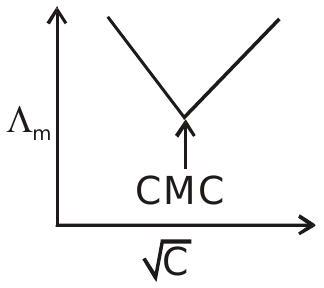
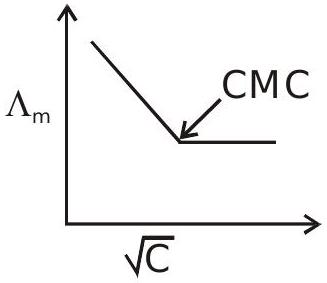
Molar conductivity () of aqueous solution of sodium stearate, which behaves as a strong electrolyte, is recorded at varying concentration(c) of sodium stearate. Which one of the following plots provides the correct representation of micelle formation in the solution?
(Critical micelle concentration (CMC) is marked with an arrow in the figures.)
  1. (A)(see structure)
  2. (B)(see structure)
  3. (C)(see structure)
    ✓ Correct
  4. (D)(see structure)

Answer: (C)

Solution

Below the CMC, sodium stearate behaves as a strong electrolyte, so molar conductivity increases with dilution (decreasing concentration) following Kohlrausch's law. At the CMC, micelle formation begins, and the effective number of free ions decreases sharply because many stearate ions aggregate into micelles. This causes a break or change in slope in the vs plot. Option (C) correctly shows increasing as decreases, with a distinct change in behavior at the CMC (marked by the arrow).

JEE Advanced · 2019 · 27 May 2019 · Paper 1 · Single correct option
More JEE Advanced questions on Surface Chemistry

  1. At a given temperature, 0.45 g of acetic acid in 50 mL of water is shaken with 1.0 g of charcoal and the pH of the resulting solution is 3.0. Assume, the adsorption of acetic acid from the aqueous solution by charcoal follows Freundlich isotherm,

    If the …
    JEE Advanced 2026View solution →
  2. Adsorption of phenol from its aqueous solution on to fly ash obeys Freundlich isotherm. At a given temperature, from and aqueous phenol solutions, the concentrations of adsorbed phenol are measured to be …
    JEE Advanced 2025View solution →
  3. To form a complete monolayer of acetic acid on 1g of charcoal, 100 mL of 0.5 M acetic acid was used. Some of the acetic acid remained unadsorbed. To neutralize the unadsorbed acetic acid, 40 mL of 1 M NaOH solution was required. If each molecule of acetic acid occupies …
    JEE Advanced 2024View solution →
  4. Consider the following statements related to colloids.
    (I) Lyophobic colloids are not formed by simple mixing of dispersed phase and dispersion medium.
    (II) For emulsions, both the dispersed phase and the dispersion medium are liquid.
    (III) Micelles are produced by dissolving a s …
    JEE Advanced 2023View solution →
  5. The correct option(s) related to adsorption processes is(are)
    JEE Advanced 2022View solution →
  6. The correct statement(s) related to colloids is(are)
    JEE Advanced 2021View solution →