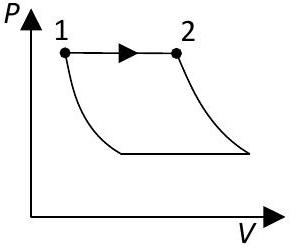
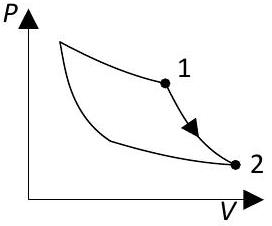
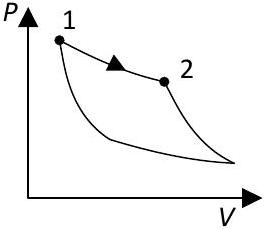
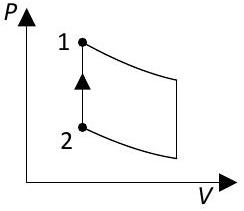
An ideal gas is undergoing a cyclic thermodynamic process in different ways as shown in the corresponding P−V diagrams in column 3 of the table. Consider only the path from state 1 to state 2. W denotes the corresponding work done on the system. The equations and plots in the table have standard notations as used in thermodynamic processes. Here γ is the ratio of heat capacities at constant pressure and constant volume. The number of moles in the gas is n.
Column 1
Column 2
Column 3
(I) W1→2=γ−11(P2V2−P1V1)
(i) Isothermal
(P) (see structure)
(II) W1→2=−PV2+PV1
(ii) Isochoric
(Q) (see structure)
(III) W1→2=0
(iii) Isobaric
(R) (see structure)
(IV) W1→2=−nRTln(V1V2)
(iv) Adiabatic
(S) (see structure)
Which one of the following options correctly represents a thermodynamic process that is used as a correction in the determination of the speed of sound in an ideal gas?PQRS
(A)(I) (ii) (Q)
(B)(IV) (ii) (R)
(C)(III) (iv) (R)
(D)(I) (iv) (Q)✓ Correct
Answer: (D)
Solution
The speed of sound in an ideal gas is determined using an adiabatic process. Newton initially assumed an isothermal process, but Laplace corrected this to an adiabatic process, which gives the correct formula v=ργP. For an adiabatic process, the work done is given by W=γ−11(P2V2−P1V1), which matches entry (I) in Column 1. Column 2 entry (iv) is "Adiabatic". Column 3 entry (Q) should show an adiabatic process (a curve steeper than an isotherm on a P-V diagram). Thus, the correct combination is (I) (iv) (Q), which is option (D).
JEE Advanced · 2017 · 21 May 2017 · Paper 1 · Single correct option