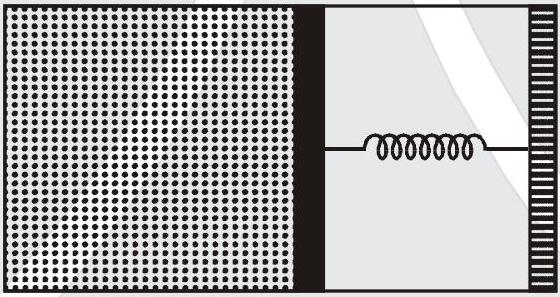
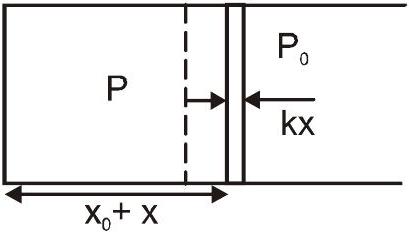
An ideal monoatomic gas is confined in a horizontal cylinder by a spring loaded piston (as shown in the figure). Initially the gas is at temperature T1, pressure P1 and volume V1 and the spring is in its relaxed state. The gas is then heated very slowly to temperature T2, pressure P2 and volume V2. During this process the piston moves out by a distance x. Ignoring the friction between the piston and the cylinder, the correct statement(s) is(are)
(A)If V2=2V1 and T2=3T1, then the energy stored in the spring is 41P1V1✓ Correct
(B)If V2=2V1 and T2=3T1, then the change in internal energy is 3P1V1✓ Correct
(C)If V2=3V1 and T2=4T1, then the work done by the gas is 37P1V1✓ Correct
(D)If V2=3V1 and T2=4T1, then the heat supplied to the gas is 617P1V1
Answer: (A), (B), (C)
Solution
The piston experiences atmospheric pressure P0=P1 and spring force. At equilibrium: P=P1+AKx.
(A) For V2=2V1 and T2=3T1: Using ideal gas law, P2=23P1. From equilibrium: 23P1=P1+AKx, giving Kx=2P1A. Since V2−V1=Ax, we have x=AV1. Energy stored: 21Kx2=4P1A⋅AV1=4P1V1. ✓
(B) Change in internal energy: ΔU=23(P2V2−P1V1)=23(23P1⋅2V1−P1V1)=3P1V1. ✓
(C) For V2=3V1 and T2=4T1: P2=34P1. Work done by gas equals work against atmosphere and spring: W=P1A⋅A2V1+21⋅3P1A⋅A2V1=2P1V1+3P1V1=37P1V1. ✓