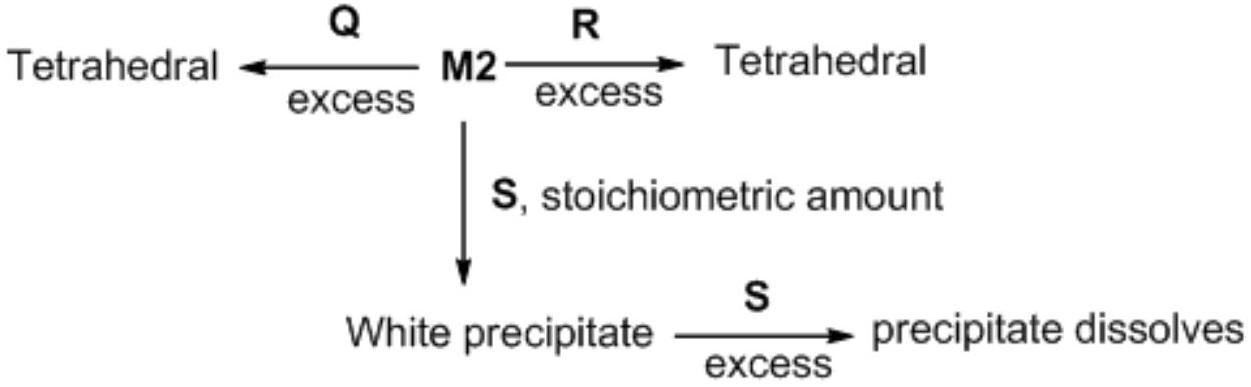
An aqueous solution of metal ion M1 reacts separately with reagents Q and R in excess to give tetrahedral and square planar complexes, respectively. An aqueous solution of another metal ion M2 always forms tetrahedral complexes with these reagents. Aqueous solution of M2 on reaction with reagent S gives white precipitate which dissolves in excess of S. The reactions are summarized in the scheme given below:
SCHEME:
M1, Q and R, respectively are
(A)Zn2+,KCN and HCl
(B)Ni2+,HCl and KCN✓ Correct
(C)Cd2+,KCN and HCl
(D)Co2+,HCl, and KCN
Answer: (B)
Solution
M1 forms both tetrahedral (with Q) and square planar (with R) complexes. Ni2+ is known to form tetrahedral complexes with Cl− ([NiCl4]2−) and square planar complexes with CN− ([Ni(CN)4]2−).
M2 always forms tetrahedral complexes and gives a white precipitate with S that dissolves in excess. This is characteristic of Zn2+, which forms tetrahedral complexes with both Cl− and CN−.
Therefore, M1 = Ni2+, Q = HCl (source of Cl−), and R = KCN (source of CN−).
JEE Advanced · 2014 · 25 May 2014 · Paper 2 · Single correct option