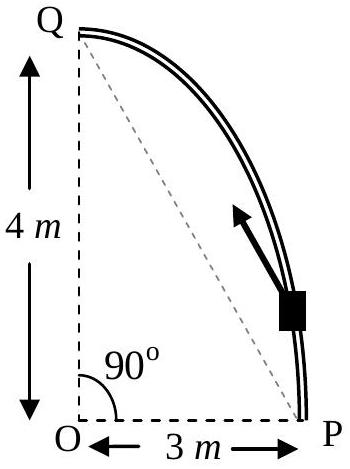
Consider an elliptically shaped rail PQ in the vertical plane with OP=3m and OQ=4m. A block of mass 1 kg is pulled along the rail from P to Q with a force of 18N, which is always parallel to line PQ (see the figure given). Assuming no frictional losses, the kinetic energy of the block when it reaches Q is (n×10) Joules. The value of n is (take acceleration due to gravity = 10ms−2 )
Answer: 5
Solution
Distance PQ: PQ=OP2+OQ2=9+16=5 m.
Work by applied force: WF=18×5=90 J.
Work by gravity: The block moves from P (height 0) to Q (height -4 m, assuming O is at P's level and Q is 4 m below). Wg=mgh=1×10×(−4)=−40 J.
By work-energy theorem: ΔKE=WF+Wg=90−40=50 J.
So n×10=50, giving n=5.
JEE Advanced · 2014 · 25 May 2014 · Paper 1 · Integer answer